
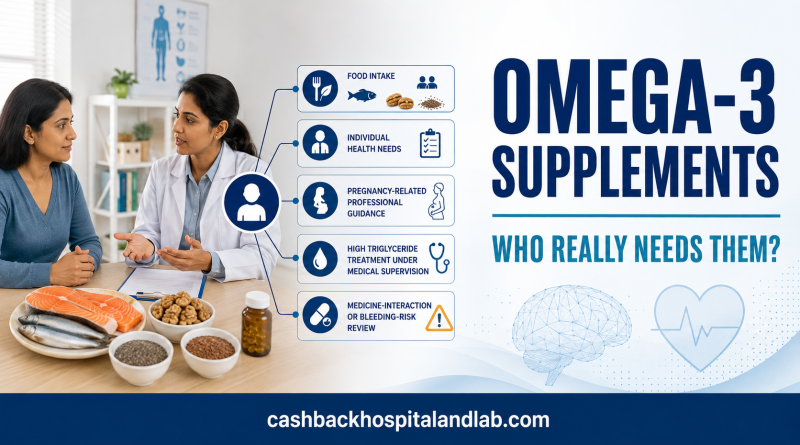
Omega-3 Supplements: Who Really Needs Them?
Benefits, Dosage, Fish Oil vs Food, Triglycerides, Heart and Brain Health, Side Effects and Who Should Be Cautious

Omega-3 supplements are among the world's most popular nutritional supplements. Fish-oil capsules are widely promoted for heart health, brain function, joints, inflammation, pregnancy, cholesterol and longevity.
Omega-3 fatty acids are genuinely important nutrients, but that does not mean everyone needs a fish-oil capsule.
For most people, the first goal should be obtaining omega-3 fats through a healthy diet. Supplements become more relevant when dietary intake is inadequate or when a particular medical indication requires a specific dose and formulation.
There is also an important distinction between an ordinary over-the-counter fish-oil supplement and prescription omega-3 medicines used to treat very high triglycerides.
Omega-3s are important—but the right source and dose depend on why you are taking them.
1. What Are Omega-3 Fatty Acids?
Omega-3 fatty acids are a family of polyunsaturated fats.
The three most commonly discussed forms are:
ALA — Alpha-Linolenic Acid
Primarily obtained from plant foods.
EPA — Eicosapentaenoic Acid
Found mainly in marine foods and fish oils.
DHA — Docosahexaenoic Acid
Found mainly in marine foods and fish oils.
They have different physiological roles.
2. ALA Is an Essential Fatty Acid
ALA is considered essential because the human body cannot make enough of it independently.
Therefore, it must come from food.
Useful ALA sources include:
Flaxseed
Chia seeds
Walnuts
Certain plant oils.
The body can convert some ALA into EPA and DHA.
However:
The conversion is relatively limited.
3. EPA and DHA
EPA and DHA are long-chain omega-3 fatty acids.
They are found primarily in:
Fatty fish
Seafood
Fish oil
Algal oil.
They become incorporated into cell membranes and participate in multiple physiological pathways.
4. Why Does the Body Need Omega-3?
Omega-3 fatty acids participate in:
Cell-membrane structure
Nervous-system function
Retinal function
Lipid metabolism
Signalling pathways
Inflammatory regulation.
DHA is particularly abundant in:
Brain tissue
Retina.
But biological importance does not automatically mean that taking extra supplements improves every health outcome.
5. Best Food Sources of EPA and DHA
Fatty fish are among the richest dietary sources.
Examples include:
Sardines
Salmon
Mackerel
Herring
Trout
depending on availability.
Different species contain different amounts of EPA and DHA.
6. Indian Sources of Omega-3
Depending on region and diet, options can include:
Sardines
Mackerel
Certain other oily fish
Flaxseed
Chia seeds
Walnuts.
For vegetarians and vegans:
Algal oil
can provide DHA and, in some products, EPA.
7. Plant Omega-3 Is Still Valuable
Some people assume plant omega-3 “doesn't count.”
That is incorrect.
ALA is itself an essential fatty acid.
Foods containing ALA often provide additional nutrients such as:
Fibre
Protein
Minerals
Polyphenols.
However, ALA and EPA/DHA should not be treated as nutritionally identical.
8. Flaxseed
Flaxseed is one of the richest commonly available plant sources of:
ALA
and also provides:
Fibre
Lignans.
Ground flaxseed is generally easier to incorporate into:
Oats
Curd
Smoothies
Meals.
Whole seeds may pass through the digestive tract less completely digested.
9. Chia Seeds
Chia seeds provide:
ALA omega-3
Fibre
Minerals.
They can be added to:
Yogurt
Oats
Other foods.
They are nutritious but do not provide large amounts of EPA and DHA directly.
10. Walnuts
Walnuts provide:
ALA
Unsaturated fats
Fibre
Plant protein.
A small portion can be incorporated into a healthy dietary pattern.
Nuts are calorie-dense, so portion size still matters.
11. Fish vs Fish-Oil Capsules
Eating fish provides more than omega-3.
Fish can provide:
Protein
Vitamin B12
Selenium
Vitamin D in some species
Other nutrients.
Therefore:
A fish-oil capsule is not nutritionally equivalent to eating fish.
12. Does Everyone Need an Omega-3 Supplement?
No.
Someone who regularly eats appropriate omega-3-rich foods may not need routine supplementation.
Whether a supplement is useful depends on:
Diet
Health conditions
Pregnancy status
Triglyceride levels
Medication use
Clinical goals.
13. Who Might Consider Omega-3 Supplements?
Supplementation may be relevant for:
People who rarely eat fish
Some vegetarians or vegans
Selected pregnant individuals
People with specific medical indications
Patients with very high triglycerides under medical supervision.
The dose and product should match the reason for supplementation.
14. Omega-3 and Heart Health
Omega-3 fatty acids have been extensively studied for cardiovascular health.
Eating fish as part of a healthy dietary pattern is associated with cardiovascular benefits.
But results from supplement trials have been more complicated.
Ordinary fish-oil capsules should not be assumed to prevent heart attacks in every healthy person.
15. Fish Oil Does Not Replace Heart-Healthy Habits
For cardiovascular prevention, major priorities include:
Not smoking
Controlling blood pressure
Managing diabetes
Treating high LDL cholesterol when appropriate
Exercising
Maintaining a healthy dietary pattern.
A supplement cannot compensate for uncontrolled cardiovascular risk factors.
16. Omega-3 and Triglycerides
This is one of the clearest medical uses.
Higher doses of:
EPA and/or DHA
can substantially reduce elevated:
Triglycerides.
However, doses used therapeutically are usually much higher and more standardized than ordinary low-dose fish-oil capsules.
17. Very High Triglycerides
Severely elevated triglycerides can increase the risk of:
Acute pancreatitis.
Management may include:
Dietary changes
Alcohol restriction or avoidance
Diabetes control
Weight management
Medication.
Prescription omega-3 may be considered in appropriate patients.
18. Prescription Omega-3 Is Different
Prescription omega-3 products provide:
Standardized active ingredients
Controlled doses
Pharmaceutical manufacturing standards.
They should not automatically be replaced with multiple over-the-counter capsules.
Treatment decisions depend on:
Triglyceride level
Cardiovascular risk
Other medications.
19. EPA-Only Prescription Therapy
One prescription formulation contains purified:
Icosapent ethyl — EPA
Research has demonstrated cardiovascular benefit in selected high-risk patients with elevated triglycerides who were already receiving statin therapy.
This does not mean ordinary fish oil provides the same benefit to everyone.
20. EPA + DHA vs EPA Alone
Omega-3 supplements can contain:
EPA
DHA
EPA + DHA.
These formulations are not interchangeable for every medical purpose.
Some cardiovascular outcome trials using combinations of EPA and DHA have not demonstrated the same benefit observed with selected prescription EPA therapy.
21. Omega-3 and LDL Cholesterol
Some omega-3 formulations containing DHA can:
Increase LDL cholesterol
in certain people while lowering triglycerides.
Therefore, treatment should consider the complete lipid profile.
Fish oil should not be thought of simply as a “cholesterol-lowering supplement.”
22. Omega-3 and HDL Cholesterol
Omega-3 supplementation may produce relatively modest effects on:
HDL cholesterol.
But increasing HDL with a supplement is not the primary treatment goal.
Cardiovascular risk management focuses more strongly on:
LDL
Blood pressure
Diabetes
Smoking
Overall risk.
23. Omega-3 and Brain Health
DHA is an important structural fatty acid in the brain.
This biological role has led to extensive marketing of DHA supplements for:
Memory
Concentration
Dementia prevention.
However:
Being important for brain biology does not prove that extra DHA prevents dementia in healthy adults.
24. Omega-3 and Memory
Research on omega-3 supplements for improving memory in healthy adults has produced mixed results.
People should not expect fish oil to function like a:
“Memory medicine.”
Cognitive health depends strongly on:
Exercise
Sleep
Blood-pressure control
Diabetes prevention
Education and cognitive activity
Social engagement.
25. Omega-3 and Dementia
Current evidence does not justify recommending routine omega-3 supplements as a proven method to prevent:
Alzheimer's disease
Dementia.
A nutritious diet containing fish where appropriate may still be part of a brain-healthy dietary pattern.
26. Omega-3 and Depression
Omega-3 supplements have been investigated in:
Depression
Mood disorders.
Some evidence suggests possible benefit in selected situations, particularly with certain EPA-dominant formulations.
However:
Omega-3 should not replace evidence-based mental-health treatment.
27. Omega-3 and Anxiety
Research into omega-3 supplementation for anxiety is ongoing.
Results are not strong enough to recommend fish oil as a standard treatment for anxiety disorders.
Diet can support mental health, but supplements should not replace appropriate assessment and care.
28. Omega-3 and Pregnancy
DHA is important for:
Fetal brain development
Retinal development.
Pregnant individuals should obtain appropriate omega-3 intake through suitable food sources and, when recommended, supplementation.
However:
Fish selection matters because mercury exposure varies by species.
29. Pregnancy and Fish
Pregnancy does not mean all fish must be avoided.
Appropriate low-mercury fish can provide valuable:
Omega-3
Protein
Iodine
Selenium
Other nutrients.
High-mercury species should be limited or avoided according to local pregnancy guidance.
30. Prenatal DHA Supplements
People who consume little or no fish may discuss a DHA-containing supplement with their healthcare professional.
Vegetarians and vegans may prefer:
Algal DHA
which is derived from microalgae rather than fish.
31. Omega-3 During Breastfeeding
DHA intake during breastfeeding contributes to the fatty-acid composition of breast milk.
Dietary needs should be individualized.
Choose products appropriate for pregnancy/lactation and avoid unnecessary high-dose supplementation.
32. Omega-3 for Children
Omega-3 fats are important nutrients during development.
However:
Not every child needs fish-oil gummies.
A healthy diet should be the foundation.
Supplementation should have a clear nutritional or clinical reason.
33. Omega-3 and ADHD
Fish oil has been studied for:
ADHD symptoms.
Some studies suggest small benefits in selected children, but effects are generally much smaller than those of established ADHD treatments.
Omega-3 should not replace appropriate clinical assessment and evidence-based treatment.
34. Omega-3 and Eye Health
DHA is abundant in the retina.
Omega-3 intake may contribute to overall nutritional health.
But fish-oil supplements should not be advertised as proven treatments for every eye disease.
Specific eye conditions require appropriate ophthalmic evaluation.
35. Omega-3 and Dry Eye
Omega-3 supplements have been widely promoted for:
Dry-eye disease.
Clinical trial results have been inconsistent.
Some people may use them as part of a broader treatment strategy, but they are not universally effective.
36. Omega-3 and Arthritis
Omega-3 fatty acids can influence inflammatory pathways.
Some research suggests higher-dose marine omega-3 may modestly improve symptoms in:
Rheumatoid arthritis.
However:
Fish oil does not cure rheumatoid arthritis.
Disease-modifying treatment remains essential when indicated.
37. Omega-3 and Joint Pain
“Joint pain” has many causes.
Fish oil may not help:
Osteoarthritis
Injury
Mechanical pain
in the same way it might influence inflammatory pathways in rheumatoid arthritis.
Do not assume every painful joint requires omega-3 supplements.
38. Omega-3 and Inflammation
EPA and DHA can influence the production of lipid mediators involved in inflammatory regulation.
But this is frequently exaggerated into claims that fish oil:
“Eliminates inflammation.”
It does not.
Inflammation is complex and sometimes necessary.
39. Omega-3 and Fatty Liver
Omega-3 supplementation can reduce triglycerides and may influence liver fat in some studies.
However:
It is not a stand-alone cure for fatty liver disease.
Management should prioritize:
Weight management when appropriate
Physical activity
Diabetes control
Healthy diet
Appropriate lipid management.
40. Omega-3 and Diabetes
People with diabetes can consume omega-3-rich foods as part of a healthy diet.
Omega-3 supplements are not a replacement for:
Glucose-lowering medication
Healthy eating
Exercise.
Their clearest role may be treating elevated triglycerides when clinically appropriate.
41. Omega-3 and Blood Pressure
Omega-3 supplementation may produce modest blood-pressure reductions in some people.
However:
Fish oil should not replace prescribed blood-pressure treatment.
Lifestyle and evidence-based medication remain the foundation.
42. Omega-3 and Exercise
Fish oil is sometimes marketed for:
Muscle growth
Recovery
Athletic performance.
Research remains mixed.
Athletes should prioritize:
Training
Protein
Calories
Sleep
Recovery
before expecting significant performance effects from fish oil.
43. Omega-3 and Muscle Health in Older Adults
Research is investigating whether omega-3 may influence:
Muscle protein metabolism
Strength
Age-related muscle loss.
Some findings are promising, but evidence does not justify treating omega-3 as a replacement for:
Resistance training + adequate protein.
44. How Much Omega-3 Do You Need?
There is no single EPA+DHA supplement dose appropriate for everyone.
Requirements depend on whether the goal is:
General nutrition
Pregnancy
Low dietary fish intake
Triglyceride treatment
A specific medical indication.
Do not confuse dietary recommendations with therapeutic prescription doses.
45. General Supplement Doses
Many ordinary fish-oil products provide a few hundred milligrams of:
EPA + DHA
per daily serving.
But the correct amount should be based on the reason for use.
More is not automatically better.
46. Therapeutic Triglyceride Doses
Prescription omega-3 treatment for severe hypertriglyceridemia commonly uses doses in the range of:
Several grams per day
under medical supervision.
Do not attempt to reproduce prescription dosing by swallowing large numbers of over-the-counter capsules without professional advice.
47. Read the EPA + DHA Amount
This is one of the most important practical points.
A bottle may say:
“Fish Oil 1000 mg”
but that does not necessarily mean it contains:
1000 mg EPA + DHA.
The capsule might contain substantially less active omega-3.
Always read:
EPA amount
DHA amount
on the supplement facts panel.
48. Fish Oil vs EPA + DHA
For example, a capsule may contain:
1,000 mg fish oil
but only a fraction of that may consist of:
EPA + DHA.
The rest consists of other fats.
Therefore:
Judge omega-3 supplements by EPA + DHA—not merely “fish oil mg.”
49. Triglyceride vs Ethyl Ester Forms
Fish-oil supplements can contain omega-3 in different chemical forms.
Examples include:
Triglycerides
Re-esterified triglycerides
Ethyl esters.
Absorption can differ, particularly depending on whether the supplement is taken with food.
However:
Product quality and actual EPA+DHA dose matter more than marketing terminology alone.
50. Should Fish Oil Be Taken With Food?
Taking omega-3 supplements with a meal—particularly one containing some fat—can improve absorption of certain formulations.
It can also sometimes reduce:
Fishy burps
Stomach discomfort.
Follow product instructions.
51. Fishy Burps
Common side effects include:
Fishy aftertaste
Burping
Indigestion.
Taking the supplement with meals may help.
Poor-quality or oxidized products may also taste or smell unpleasant.
52. Omega-3 Side Effects
Possible adverse effects include:
Nausea
Diarrhoea
Heartburn
Abdominal discomfort
Fishy aftertaste.
Most are mild at ordinary doses.
Higher doses require more careful consideration.
53. Omega-3 and Bleeding
Omega-3 fatty acids can influence platelet biology.
At typical dietary and supplement doses, major bleeding risk appears relatively low for most people.
However, people taking:
Anticoagulants
Antiplatelet medicines
or those with bleeding disorders should discuss high-dose supplementation with their healthcare professional.
54. Omega-3 Before Surgery
Do not automatically stop fish oil before surgery without advice.
Recommendations vary according to:
Dose
Procedure
Other medications
Individual bleeding risk.
Tell the surgical team about all supplements.
55. Omega-3 and Atrial Fibrillation
This is an important safety consideration.
Some large trials have found an increased risk of:
Atrial fibrillation
with certain high-dose omega-3 regimens.
This does not mean ordinary dietary fish causes AFib.
But it reinforces an important principle:
High-dose supplementation should have a clear reason.
56. What Is Atrial Fibrillation?
Atrial fibrillation is an abnormal heart rhythm that can cause:
Palpitations
Shortness of breath
Fatigue
Dizziness
and can increase stroke risk.
People with a history of AFib should discuss high-dose omega-3 supplementation with their clinician.
57. Omega-3 and Prostate Cancer
Older observational research raised questions about omega-3 and prostate cancer.
Overall evidence has not established that ordinary omega-3 intake causes prostate cancer.
People should avoid drawing strong conclusions from isolated studies.
58. Fish-Oil Quality
Supplement quality matters.
Potential issues include:
Oxidation
Contamination
Incorrect EPA/DHA content
Poor storage.
Choose reputable manufacturers and credible independent testing when available.
59. Oxidized Fish Oil
Omega-3 fats are vulnerable to oxidation.
Signs of poor quality may include:
Strong rancid smell
Unusually unpleasant taste.
Store products according to manufacturer instructions and pay attention to expiration dates.
60. Heavy Metals
People sometimes worry about mercury in fish-oil supplements.
Quality purification processes can substantially reduce contaminants.
Nevertheless:
Manufacturing quality matters.
This is another reason to choose reputable products.
61. Cod Liver Oil Is Different
Cod liver oil provides:
Omega-3 fatty acids
but also contains:
Vitamin A
Vitamin D.
This makes it different from standard fish oil.
Large amounts can lead to excessive intake of fat-soluble vitamins.
62. Pregnancy and Cod Liver Oil
Pregnant people should be particularly cautious with products containing high amounts of:
Preformed vitamin A (retinol).
Excessive retinol during pregnancy can be harmful.
Do not assume cod liver oil and ordinary prenatal DHA are interchangeable.
63. Krill Oil
Krill oil provides EPA and DHA, often in phospholipid forms.
It is frequently marketed as:
Better absorbed
More powerful
Superior to fish oil.
Evidence does not establish that krill oil provides dramatically better health outcomes.
It is often more expensive.
64. Algal Oil
Algal oil is produced from:
Microalgae.
It can provide:
DHA
and some products also provide:
EPA.
It is particularly useful for:
Vegetarians
Vegans
People avoiding fish.
65. Vegan Omega-3
For someone who does not consume fish:
Flaxseed
Chia
Walnuts
can provide ALA.
An algae-derived EPA/DHA supplement can be considered when direct long-chain omega-3 intake is desired.
66. Omega-6 vs Omega-3
Social media often claims that omega-6 fats are inherently inflammatory and must be drastically reduced.
This is an oversimplification.
Omega-6 fatty acids are also:
Essential nutrients.
Replacing saturated fats with appropriate polyunsaturated fats can support cardiovascular health.
67. Do You Need a Perfect Omega-6:Omega-3 Ratio?
There is no need for most people to calculate every meal's:
Omega-6 : Omega-3 ratio.
A more practical approach is:
Eat omega-3-rich foods regularly
Use appropriate unsaturated fats
Limit excessive highly processed foods
Maintain an overall healthy diet.
68. Omega-3 and Seed Oils
Seed oils are sometimes blamed for inflammation because they contain omega-6 fatty acids.
But evidence does not support treating ordinary omega-6-rich vegetable oils as inherently toxic.
The complete dietary pattern matters more.
69. Omega-3 Supplement Myths vs Facts
| MYTH | FACT |
|---|---|
| Everyone needs fish oil | Many people can obtain omega-3 from food |
| Fish oil prevents every heart attack | Supplement benefits depend on the population and formulation |
| More omega-3 is always better | High doses can have risks |
| Fish oil lowers all cholesterol | Some formulations can increase LDL |
| DHA prevents dementia | This has not been established |
| Omega-3 cures depression | It may have adjunctive roles but does not replace treatment |
| Fish oil cures arthritis | It may modestly help selected inflammatory conditions |
| 1,000 mg fish oil means 1,000 mg omega-3 | Check actual EPA + DHA |
| Krill oil is always superior | Strong evidence of superior outcomes is lacking |
| Plant omega-3 is useless | ALA is an essential fatty acid |
| Omega-6 is toxic | Omega-6 fatty acids are also essential |
| Supplements are always safer than medicines | High-dose omega-3 can have adverse effects |
70. Who May Benefit Most?
Omega-3 supplementation may be particularly reasonable for:
People with very low fish intake
Vegetarians/vegans considering algal EPA/DHA
Selected pregnant people with inadequate DHA intake
Patients prescribed omega-3 for high triglycerides
Certain individuals with specific clinician-directed indications.
71. Who Should Be Cautious?
Discuss supplementation—particularly high doses—if you have:
Atrial fibrillation
A bleeding disorder
Significant liver disease
Fish or shellfish allergy
Upcoming surgery
Multiple cardiovascular medications
or if you take:
Anticoagulants
Antiplatelet medicines.
72. Fish Allergy
People with fish allergy should not assume every fish-oil product is safe.
Discuss alternatives with an appropriate professional.
Algal omega-3
may be an option for some individuals.
73. A Food-First Omega-3 Strategy
If you eat fish:
Include appropriate oily fish regularly as part of a balanced diet.
If you do not eat fish:
Include flaxseed
Chia seeds
Walnuts
and consider whether an algal EPA/DHA product is appropriate for your needs.
Food provides more than isolated fatty acids.
74. Example Omega-3-Rich Day
BREAKFAST
Oats + ground flaxseed + fruit + plain curd
LUNCH
Dal + vegetables + whole-grain roti + salad
SNACK
A small portion of walnuts
DINNER
Oily fish + vegetables + appropriate whole grain
Vegetarian alternative: tofu/legumes with an appropriate algae-derived supplement if needed.
75. How to Choose an Omega-3 Supplement
Check:
EPA per serving
DHA per serving
Total EPA + DHA
Serving size
Expiration date
Manufacturer quality
Independent testing where available.
Do not choose solely by:
“Fish Oil 1000 mg”
printed on the front.
76. Supplement Checklist
Before taking omega-3, ask:
Why am I taking it?
Do I regularly eat fish?
Do I need EPA, DHA or both?
How much EPA+DHA does the product actually contain?
Am I taking blood-thinning medicines?
Do I have AFib?
Am I pregnant?
Is this ordinary supplementation or treatment for high triglycerides?
The purpose should determine the product.
77. Ayurveda and Omega-3
Omega-3 fatty acids are nutrients defined by modern nutritional science and should not be presented as classical Ayurvedic compounds.
Traditional Indian dietary practices can nevertheless provide nutrient-rich foods such as:
Walnuts
Flaxseed
Sesame
Legumes
Fish in communities where it is consumed.
Ayurveda's broader dietary concepts should not be directly equated with EPA, DHA or modern lipid metabolism.
The Bottom Line
Omega-3 fatty acids are important for human health.
Good dietary sources include:
🐟 Fatty fish
🌱 Flaxseed
🌱 Chia seeds
🥜 Walnuts
🌊 Algal oil where appropriate.
Supplements can be useful, but:
Not everyone needs them.
The strongest reasons for supplementation include:
Inadequate dietary intake
Selected pregnancy-related needs
Vegetarian/vegan need for direct DHA/EPA
Specific clinician-directed indications
Prescription treatment of high triglycerides.
And remember:
1,000 mg fish oil does not necessarily equal 1,000 mg EPA + DHA.
Always read the label carefully.
Conclusion
Omega-3 supplements are useful tools—not universal insurance against disease.
You do not need to take fish oil simply because:
You are over 40
You want better memory
You exercise
You have occasional joint pain
Someone online says everyone is deficient.
Instead:
Eat omega-3-rich foods regularly.
Use supplements when there is a clear reason.
Check the actual EPA + DHA dose.
Do not substitute OTC fish oil for prescription omega-3 therapy.
Be cautious with high doses, particularly with AFib or interacting medications.
Choose reputable, appropriately tested products.
The best question is not:
“Which omega-3 supplement should everyone take?”
It is:
“Do I actually need one—and what am I trying to achieve with it?”
Disclaimer: This article is for general educational purposes and does not replace individualized medical or nutritional advice. Omega-3 requirements and supplement safety vary according to diet, pregnancy, medical conditions, medications and treatment goals.
cashbackhospitalandlab.com