Abhyanga Oil Massage: Benefits for Modern Lifestyle
Modern lifestyles often involve long sitting hours, screen exposure, irregular sleep, physical inactivity, demanding schedules and persistent stress. Ayurveda's traditional daily routine—Dinacharya (दिनचर्या)—includes several practices intended to support long-term wellbeing. One of the best known is Abhyanga (अभ्यङ्ग), the application and massage of oil over the body.
Abhyanga is often described online as a “detox massage” or a treatment that removes toxins through the skin. Classical Ayurveda gives it a much broader role, particularly in relation to Vata, fatigue, nourishment, sleep and skin health.
Modern research also supports several general benefits of massage, especially for relaxation, stress, muscle discomfort and wellbeing, although many specific claims made about Ayurvedic oil massage remain inadequately studied.
1. What Is Abhyanga?
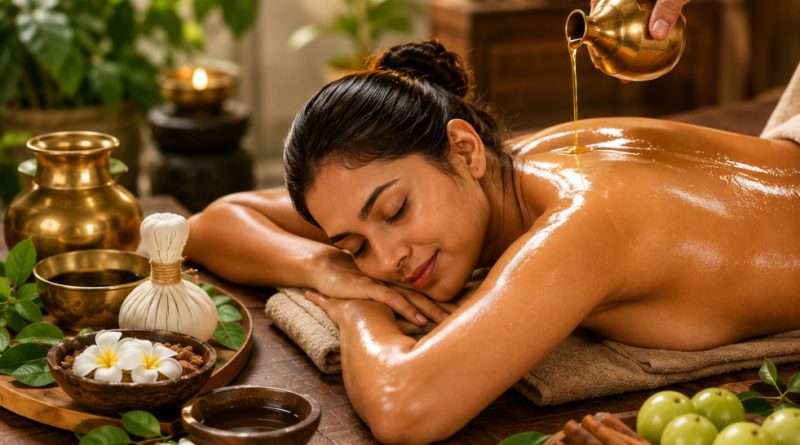
Abhyanga (अभ्यङ्ग) refers to the therapeutic application of oil to the body, usually accompanied by gentle or moderate massage.
Depending on the purpose, Ayurveda may use:
- Plain oils
- Herbal medicated oils
- Region-specific applications
- Full-body Abhyanga
- Head massage
- Foot massage
- Therapeutic massage under professional supervision
Abhyanga may be incorporated into Dinacharya, therapeutic care or preparation for selected Panchakarma procedures.
2. The Classical Shloka on Abhyanga
One of Ayurveda's most frequently cited descriptions appears in Ashtanga Hridaya, Sutrasthana 2/8:
अभ्यङ्गमाचरेन्नित्यं स जराश्रमवातहा।
दृष्टिप्रसादपुष्ट्यायुः स्वप्नसुत्वक्त्वदार्ढ्यकृत्॥
Meaning
Regular Abhyanga is traditionally described as helping to:
- Reduce fatigue
- Pacify aggravated Vata
- Support nourishment
- Promote sleep
- Support skin quality
- Promote strength and wellbeing
This verse provides the classical rationale for including oil massage within a healthy daily routine.
3. Abhyanga and Vata Dosha
Ayurveda describes Vata as having qualities such as:
Ruksha (dry) + Laghu (light) + Chala (mobile) + Sheeta (cold).
Oil possesses qualities that can oppose dryness and excessive mobility.
This explains why Abhyanga is traditionally emphasized for Vata-predominant states.
In everyday life, an Ayurvedic practitioner might consider it particularly useful when someone experiences:
- Dry skin
- Physical fatigue
- Irregular routine
- Feeling physically tense
- Poor relaxation
- Age-related dryness
These are traditional applications rather than modern medical diagnoses.
4. Why Abhyanga Fits the Modern Lifestyle
Many people spend hours:
- Sitting at desks
- Using smartphones
- Driving
- Working on computers
- Remaining physically inactive
- Sleeping irregularly
This may contribute to stiffness, muscular discomfort and mental fatigue.
Abhyanga can create a structured period for movement, tactile stimulation, relaxation and body awareness.
It may therefore be useful even without invoking complicated “detox” explanations.
5. Abhyanga and Stress
Massage can activate physiological responses associated with relaxation.
People commonly report:
- Reduced subjective stress
- Physical relaxation
- Reduced muscle tension
- Improved sense of wellbeing
The ritual itself can also provide a break from constant digital stimulation.
Practical idea:
10–15 minutes without your phone + gentle self-massage + warm shower
may be a useful evening routine for some people.
6. Abhyanga and Sleep
Classical Ayurveda specifically associates Abhyanga with Swapna (sleep).
The verse states:
...स्वप्नसुत्वक्त्वदार्ढ्यकृत्॥
Regular massage and relaxation before bedtime may help some people unwind.
Modern massage research also suggests possible improvements in relaxation and sleep in selected populations.
However, Abhyanga should not be advertised as a guaranteed treatment for chronic insomnia.
Persistent sleep problems may require evaluation for conditions such as sleep apnea, depression, anxiety, medication effects or other disorders.
7. Abhyanga and Muscle Tension
Long hours of desk work can contribute to discomfort in areas such as:
- Neck
- Shoulders
- Upper back
- Lower back
- Forearms
- Legs
Massage can temporarily reduce muscular tension and promote relaxation.
However, persistent pain, weakness, numbness or radiating pain should not simply be repeatedly massaged.
Such symptoms may require medical or physiotherapy assessment.
8. Abhyanga and Skin
Oil application can function as an emollient, helping reduce water loss from the skin and improve softness.
It may be especially useful for people with dry skin.
Potential benefits include:
- Improved skin lubrication
- Reduced sensation of dryness
- Softer skin
- Improved comfort
But oils are not appropriate for every skin condition.
9. MYTH: Abhyanga Removes Toxins Through the Skin
❌ MYTH
“Oil pulls toxins out through the pores.”
✅ FACT
There is insufficient evidence that oil massage extracts unspecified toxins from the bloodstream or tissues through the skin.
The body's major systems for processing and eliminating metabolic wastes include the:
- Liver
- Kidneys
- Gastrointestinal tract
- Lungs
Abhyanga can still be beneficial for relaxation and skin care without making unsupported detoxification claims.
10. MYTH: More Oil Means More Benefit
❌ MYTH
“The more oil you apply, the stronger the treatment.”
✅ FACT
Excessive oil is unnecessary.
For home Abhyanga, enough oil to provide comfortable lubrication is usually sufficient.
Too much oil can:
- Make floors dangerously slippery
- Stain clothing
- Be difficult to remove
- Aggravate certain skin problems
Treatment should be comfortable rather than excessive.
11. Which Oil Is Best?
There is no universally “best” Ayurvedic massage oil.
Selection traditionally depends on:
Prakriti + Vikriti + season + climate + age + skin + therapeutic goal.
Common choices include:
- Sesame oil
- Coconut oil
- Selected herbal oils
- Other suitable carrier oils
Patch testing is sensible when using a new product.
12. Sesame Oil – Tila Taila
Sesame oil is one of the most important traditional oils in Ayurveda.
It is commonly used in Vata-oriented massage because of its warming and unctuous qualities.
It may suit people with dry skin, especially in cooler weather.
However, people with sesame allergy should avoid it.
13. Coconut Oil
Coconut oil is often preferred in warmer climates and is traditionally considered more cooling.
It can act as an effective skin emollient.
However, some people may find it too occlusive or unsuitable for acne-prone areas.
The correct oil depends partly on individual skin response.
14. Medicated Ayurvedic Oils
Ayurveda uses many Taila preparations containing herbal ingredients.
Examples commonly encountered include:
- Mahanarayana Taila
- Dhanvantaram Taila
- Ksheerabala Taila
- Bala Taila
- Brahmi-containing oils
Different formulations have different traditional indications.
“Ayurvedic oil” does not mean every oil is suitable for every person.
15. How to Perform Simple Self-Abhyanga
A practical home routine can be simple:
- Choose an appropriate oil.
- Warm it gently if suitable.
- Apply a small amount to the skin.
- Massage gently rather than aggressively.
- Use comfortable strokes over muscles.
- Avoid injured or irritated areas.
- Allow a short period of relaxation.
- Bathe or shower according to preference.
A home routine does not need to imitate intensive therapeutic massage.
16. How Long Should Abhyanga Take?
There is no requirement that everyday self-Abhyanga last an hour.
For modern routines:
10–20 minutes may be practical.
Consistency may be more useful than performing an elaborate routine occasionally.
Even shorter massage of selected areas can be incorporated into a busy schedule.
17. Head Massage
Ayurveda traditionally gives importance to oil application on the head.
Gentle scalp massage may provide:
- Relaxation
- A pleasant sensory experience
- Temporary relief of scalp tightness
- Hair conditioning depending on the oil
However, scalp oil cannot reliably treat every cause of hair loss.
Persistent hair loss may require assessment for nutritional, hormonal, autoimmune or genetic causes.
18. Padabhyanga – Foot Massage
Ayurveda gives particular importance to Padabhyanga, or foot massage.
For modern lifestyles, a brief evening foot massage may be useful as a relaxation ritual.
It can be especially pleasant after:
- Prolonged standing
- Walking
- Travel
- A demanding workday
Avoid strong massage over acute injuries or infected skin.
19. Abhyanga Before or After Exercise?
Gentle massage may be relaxing around an exercise routine, but deep massage immediately before demanding athletic performance may not always be desirable.
After exercise, gentle massage can provide subjective relief from soreness and tension.
Hydration, nutrition, recovery and appropriate training remain more important than massage alone.
20. Abhyanga for Older Adults
Older adults often experience:
- Dry skin
- Reduced mobility
- Muscle stiffness
- Sleep difficulties
Gentle oil massage may provide comfort and skin moisturization.
However, additional precautions may be needed for people with:
- Fragile skin
- Osteoporosis
- Anticoagulant therapy
- Poor balance
- Neuropathy
- Circulatory disorders
Pressure should be gentle and individualized.
21. Abhyanga During Pregnancy
Gentle massage can be comfortable during pregnancy when medically appropriate.
However:
- Positioning matters
- Pressure should be appropriate
- Certain essential oils should be avoided
- High-risk pregnancies require medical guidance
Pregnant women should not undergo aggressive therapeutic massage simply because it is described as Ayurvedic.
22. When Should Abhyanga Be Avoided?
Avoid or obtain professional advice before massage when there is:
- Fever or significant acute illness
- Active skin infection
- Open wounds
- Recent significant injury
- Suspected fracture
- Acute severe inflammation
- Unexplained swelling
- Suspected blood clot
- Severe uncontrolled pain
- Serious cardiovascular instability
Massage should never delay diagnosis of an acute medical problem.
23. Deep Vein Thrombosis – Important Warning
Do not massage a leg with suspected DVT.
Warning signs can include:
- New one-sided leg swelling
- Pain or tenderness
- Warmth
- Skin colour change
A suspected blood clot requires urgent medical assessment.
24. Essential Oils Require Caution
Essential oils are highly concentrated.
They should not automatically be applied directly to the skin.
Potential problems include:
- Irritation
- Allergic contact dermatitis
- Photosensitivity with certain oils
- Toxicity if swallowed
If used, they should be appropriately diluted and selected according to individual safety considerations.
25. Abhyanga and Mental Wellbeing
Touch and massage can contribute to:
- Relaxation
- Body awareness
- A sense of calm
- Time away from screens
- Structured self-care
These effects can be meaningful.
But massage is not a substitute for appropriate treatment of severe anxiety, depression or other mental-health conditions.
26. Abhyanga and Blood Circulation
Massage is often said to “improve circulation.”
Local blood flow may change during and after massage, but broad claims that Abhyanga “cleans arteries” or permanently improves systemic circulation are not justified.
People with vascular disease should obtain appropriate medical care.
27. Abhyanga and Lymphatic Detox
MYTH:
“Abhyanga pushes toxins out through the lymphatic system.”
FACT:
The lymphatic system has important roles in fluid balance and immune function, but ordinary oil massage has not been shown to eliminate unspecified toxins.
Specialized manual lymphatic drainage is a distinct clinical technique and may be used for selected conditions such as lymphedema under appropriate guidance.
28. Abhyanga as Part of Panchakarma
Abhyanga may be used as part of Snehana, particularly during preparation for selected Panchakarma procedures.
In this context, it is not simply a relaxation massage.
The oil, technique, duration and accompanying procedures may be selected according to the therapeutic plan.
Home self-Abhyanga and clinical Panchakarma preparation should therefore not be treated as identical.
29. Abhyanga vs Spa Massage
Ayurvedic Abhyanga
Traditionally individualized according to Ayurvedic assessment and often uses specific oils and therapeutic principles.
General Spa Massage
Usually focuses primarily on relaxation, comfort and muscular massage.
Both may feel relaxing, but their theoretical frameworks and therapeutic objectives differ.
30. What Does Science Say?
Modern research on massage therapy in general suggests possible benefits for:
- Short-term pain relief in some conditions
- Stress reduction
- Relaxation
- Anxiety symptoms in selected populations
- Muscle soreness
- Quality of life
- Sleep in certain groups
However, research specifically evaluating traditional Ayurvedic Abhyanga is considerably more limited.
Many studies are small or combine massage with several other Ayurvedic therapies, making it difficult to determine the effect of Abhyanga alone.
Therefore, claims that Abhyanga:
- Removes toxins
- Cures chronic disease
- Permanently corrects Doshas
- Treats neurological disease
- Produces major weight loss
are not supported by strong clinical evidence.
Abhyanga: Myths vs Facts
| MYTH | FACT |
|---|---|
| Abhyanga pulls toxins through the skin | Evidence does not support this claim |
| Everyone needs the same oil | Oil choice should be individualized |
| More pressure gives better results | Excessive pressure can cause injury |
| More oil means stronger therapy | A comfortable amount is sufficient |
| Abhyanga cures chronic pain | It may provide temporary symptom relief |
| Massage permanently improves circulation | Evidence does not support broad claims |
| Natural oils never cause allergies | Oils and herbs can trigger reactions |
| Daily massage is compulsory for everyone | Frequency should suit the individual |
| Abhyanga replaces exercise | Exercise provides different health benefits |
| Massage is safe during every illness | Several conditions require avoidance or caution |
Abhyanga for the Modern Lifestyle
A practical routine might look like:
Morning or evening
↓
Put the phone away
↓
5–15 minutes of gentle oil massage
↓
Focus on dry or tense areas
↓
Relax for a few minutes
↓
Warm shower if desired
↓
Regular exercise + balanced diet + good sleep
↓
Simple, Sustainable Self-Care
Conclusion
Abhyanga is one of Ayurveda's most accessible traditional lifestyle practices.
The classical description:
अभ्यङ्गमाचरेन्नित्यं स जराश्रमवातहा...
highlights its traditional association with reducing fatigue, pacifying Vata, supporting nourishment, sleep and skin health.
For modern lifestyles, its most realistic benefits may include:
Relaxation + skin moisturization + reduced muscular tension + body awareness + a structured break from screens and stress.
The strongest approach is not to portray Abhyanga as a miraculous detox or cure.
Instead, use it as one component of a healthy routine alongside:
Regular physical activity + nutritious food + sufficient sleep + stress management + appropriate medical care.
Abhyanga is best understood as supportive self-care—not a replacement for diagnosis or treatment.
Disclaimer: This article is for educational purposes only and does not replace medical diagnosis or treatment. Avoid massage over infections, open wounds, acute injuries or suspected blood clots. People who are pregnant, medically fragile, taking anticoagulants or living with significant medical conditions should seek appropriate professional advice before therapeutic massage.
cashbackhospitalandlab.com