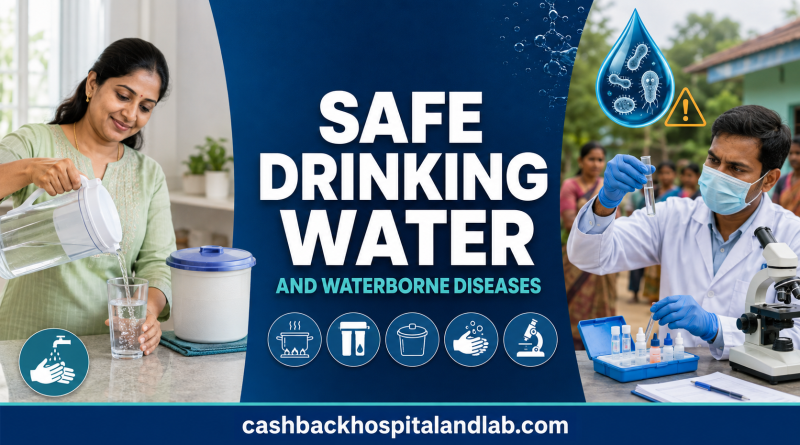
Safe Drinking Water and Waterborne Diseases
Safe drinking water is essential for good health. Water that looks clean, tastes normal and has no unpleasant smell can still contain disease-causing bacteria, viruses, parasites or harmful chemicals.
Contaminated drinking water can contribute to illnesses ranging from mild diarrhoea to serious infections such as cholera, typhoid fever and hepatitis A or E. The risk may increase after heavy rainfall, flooding, sewage leakage, damaged pipelines or unsafe water storage.
The most important principle is simple:
Safe water must be protected from the source to the point where it is actually consumed.
What Is Safe Drinking Water?
Safe drinking water should be suitable for human consumption and free from harmful levels of:
- Disease-causing microorganisms
- Toxic chemicals
- Harmful contaminants
Water safety involves more than purification.
It also depends on:
- Safe collection
- Safe transportation
- Clean storage
- Hygienic handling
- Prevention of recontamination
Even properly treated water can become unsafe if stored in a dirty container.
What Are Waterborne Diseases?
Waterborne diseases are illnesses that can occur when people consume water contaminated with disease-causing microorganisms.
Contamination frequently results from human or animal faecal matter entering the water supply.
Common water-associated infections include:
- Acute diarrhoeal diseases
- Cholera
- Typhoid fever
- Hepatitis A
- Hepatitis E
- Giardiasis
- Cryptosporidiosis
- Certain forms of dysentery
Some illnesses associated with water exposure are transmitted through routes other than simply drinking contaminated water, so the term “waterborne” should be used carefully.
How Does Drinking Water Become Contaminated?
Contamination can occur at many points.
Possible causes include:
- Sewage entering drinking-water supplies
- Broken or leaking pipelines
- Flooding
- Contaminated wells
- Poor sanitation
- Unsafe water tanks
- Dirty household storage containers
- Contaminated hands or utensils
- Animal waste
- Agricultural runoff
- Industrial pollution
Water may therefore become contaminated before or after it reaches your home.
Why Does Waterborne Disease Increase During the Monsoon?
Heavy rainfall can overwhelm drainage and sewage systems.
Floodwater may mix with:
- Sewage
- Animal waste
- Garbage
- Contaminated soil
Leaks or low pressure in damaged water pipelines can allow contaminated material to enter the drinking-water network.
For this reason, extra precautions may be appropriate after:
- Flooding
- Sewage overflow
- Pipeline damage
- Local water contamination alerts
Common Symptoms of Waterborne Disease
Symptoms depend on the infection but commonly include:
- Diarrhoea
- Vomiting
- Nausea
- Abdominal cramps
- Fever
- Weakness
- Loss of appetite
Some illnesses may also cause:
- Blood in stool
- Jaundice
- Severe dehydration
- Persistent high fever
Symptoms alone cannot always identify the responsible organism.
Diarrhoea and Dehydration
The most immediate danger from many gastrointestinal infections is dehydration.
Diarrhoea and vomiting cause loss of:
- Water
- Sodium
- Potassium
- Other electrolytes
Young children and older adults can become dehydrated particularly quickly.
Signs of Dehydration
Watch for:
- Thirst
- Dry mouth
- Dark urine
- Reduced urination
- Weakness
- Dizziness
More serious warning signs include:
- Very little or no urine
- Extreme sleepiness
- Confusion
- Fainting
- Inability to drink
Severe dehydration requires prompt medical care.
ORS Can Save Lives
Oral Rehydration Solution (ORS) is one of the most important treatments for dehydration caused by acute diarrhoea.
ORS contains water, glucose and electrolytes in appropriate proportions.
Use commercially prepared ORS according to the packet instructions.
Do not:
- Add extra salt
- Add extra sugar
- Mix it with less water than instructed
An incorrectly concentrated solution can be harmful.
Cholera
Cholera is an acute diarrhoeal infection caused by toxigenic Vibrio cholerae.
Some infections are mild, but severe cholera can cause:
- Profuse watery diarrhoea
- Vomiting
- Rapid fluid loss
- Severe dehydration
- Shock
Severe dehydration can become life-threatening quickly.
The foundation of cholera treatment is rapid and appropriate rehydration.
Typhoid Fever
Typhoid fever is caused by Salmonella Typhi.
It spreads primarily through food or water contaminated with faecal material from an infected person or carrier.
Symptoms can include:
- Persistent fever
- Headache
- Weakness
- Abdominal discomfort
- Reduced appetite
- Diarrhoea or constipation
Typhoid requires appropriate medical diagnosis and antibiotic treatment.
Does the Widal Test Confirm Typhoid?
Not by itself.
The Widal test has important limitations, particularly in areas where background antibodies may be common.
Depending on the stage of illness and clinical circumstances, blood culture can be particularly useful for diagnosing typhoid.
Laboratory results should be interpreted together with symptoms and medical assessment.
Hepatitis A
Hepatitis A is a viral infection affecting the liver.
It can spread through contaminated food and water.
Symptoms may include:
- Fever
- Fatigue
- Nausea
- Poor appetite
- Abdominal discomfort
- Dark urine
- Pale stool
- Yellowing of the eyes or skin
Vaccination can help prevent hepatitis A.
Hepatitis E
Hepatitis E is another viral infection that can spread through contaminated water.
Many people recover without complications, but infection can be particularly concerning during pregnancy, where the risk of severe disease can be higher in some settings.
Pregnant people with jaundice or suspected hepatitis should seek prompt medical assessment.
Giardiasis
Giardiasis is caused by the parasite Giardia.
Symptoms may include:
- Diarrhoea
- Bloating
- Gas
- Abdominal cramps
- Nausea
- Weight loss
Persistent diarrhoea following consumption of questionable water deserves medical assessment.
Cryptosporidiosis
Cryptosporidium is a parasite that can cause watery diarrhoea.
It is important because its infectious stages can be relatively resistant to commonly used chlorine concentrations.
People with significantly weakened immune systems may be at greater risk of prolonged or severe disease.
Dysentery
Dysentery generally refers to diarrhoea containing visible blood, often accompanied by abdominal cramps.
Possible causes include bacterial and parasitic infections.
Bloody diarrhoea should not simply be treated at home with random antibiotics or anti-diarrhoeal medication.
Medical evaluation is appropriate.
Can Clear Water Still Be Unsafe?
Yes.
This is one of the most important water-safety lessons.
Microorganisms that cause disease are usually too small to see.
Therefore:
Clear water ≠ microbiologically safe water.
Likewise, water that:
- Has no smell
- Tastes normal
- Looks transparent
may still contain harmful microorganisms.
Does Boiling Make Water Safe?
Boiling is an effective household method for killing many disease-causing microorganisms.
If authorities issue a boil-water advisory, follow their specific instructions.
After boiling:
- Allow the water to cool safely.
- Keep it covered.
- Store it in a clean container.
- Avoid dipping dirty cups or hands into it.
Boiling does not necessarily remove every chemical contaminant.
Boiling Does Not Remove All Chemicals
Boiling is primarily a microbial treatment method.
It does not reliably remove contaminants such as:
- Arsenic
- Excess fluoride
- Nitrates
- Many dissolved salts
- Certain industrial pollutants
In some situations, boiling may actually concentrate dissolved substances because some water evaporates.
If chemical contamination is suspected, appropriate water testing and treatment are necessary.
Water Filters: Are They Enough?
It depends on the filter.
Different filtration technologies remove different contaminants.
A filter may target:
- Sediment
- Bacteria
- Protozoa
- Certain chemicals
- Dissolved salts
No household filter should be assumed to remove everything.
The correct system depends on the quality of the incoming water.
RO Water Purifiers
Reverse osmosis (RO) can reduce many dissolved substances.
However, RO is not automatically necessary for every household.
Whether it is appropriate depends on:
- Total dissolved solids
- Specific contaminants
- Local water quality
- Source of water
Water-treatment decisions should ideally be based on actual water quality, not marketing claims.
UV Water Purifiers
Ultraviolet (UV) systems can inactivate many microorganisms when appropriately designed and maintained.
However, UV:
- Does not remove dissolved chemicals
- Does not remove salts
- Works best when water is sufficiently clear
- Requires proper maintenance and functioning equipment
No treatment technology solves every water-quality problem.
Household Chlorination
Chlorine can disinfect drinking water when used at an appropriate concentration and contact time.
However, incorrect dosing can make treatment ineffective or create unnecessary exposure.
Follow:
- Public-health instructions
- Product directions
- Local water-treatment recommendations
Do not estimate chemical quantities casually.
Safe Water Storage
Water can become contaminated after treatment.
Store drinking water in containers that are:
- Clean
- Covered
- Food-safe
- Easy to clean
A container with a narrow opening or dispensing tap can reduce hand contact with stored water.
Avoid Dipping Hands or Cups Into Stored Water
Repeatedly dipping:
- Hands
- Glasses
- Cups
- Ladles
into a water container can introduce microorganisms.
Whenever possible, pour water or use a clean dispensing tap.
This helps prevent recontamination after treatment.
Clean Household Water Tanks
Overhead and underground water tanks require appropriate maintenance.
Possible problems include:
- Sediment buildup
- Insects
- Animal contamination
- Damaged covers
- Leakage
- Biofilm
Keep tanks securely covered and inspect them periodically.
Cleaning frequency should depend on water quality, system design and local recommendations.
Well Water Safety
Private wells can become contaminated after:
- Flooding
- Heavy rainfall
- Sewage leakage
- Septic-system failure
- Agricultural runoff
If a well has been flooded, do not assume the water is safe simply because it becomes clear again.
Testing and appropriate disinfection may be necessary.
Water Testing
Water testing can help detect problems that cannot be seen.
Depending on the situation, testing may evaluate:
- Coliform bacteria
- E. coli
- Turbidity
- pH
- Total dissolved solids
- Nitrates
- Fluoride
- Arsenic
- Other local contaminants
The appropriate tests depend on the water source and regional risks.
What Does E. coli in Drinking Water Mean?
Detection of E. coli in drinking water is an important indicator of faecal contamination.
It suggests that disease-causing microorganisms may have entered the water supply.
Such findings require prompt investigation and corrective action.
TDS Does Not Tell You Whether Water Has Germs
A TDS meter measures total dissolved solids.
It does not directly detect:
- Bacteria
- Viruses
- Parasites
Therefore, a “good” TDS reading does not prove that water is microbiologically safe.
Likewise, a high TDS value does not automatically mean infectious contamination.
Bottled Water Safety
Sealed packaged drinking water can be convenient, but safety depends on:
- Manufacturing quality
- Storage
- Packaging integrity
- Authenticity
Avoid bottles with:
- Broken seals
- Damaged packaging
- Suspicious labeling
Do not assume that every bottle sold commercially is automatically safe.
Ice Can Also Transmit Infection
Ice made from contaminated water can carry microorganisms.
When water safety is uncertain, be cautious about:
- Ice cubes
- Crushed ice
- Ice used in beverages
Freezing does not reliably sterilize contaminated water.
Raw Fruits and Vegetables
Produce can become contaminated through:
- Irrigation water
- Washing water
- Handling
- Food-preparation surfaces
Wash fruits and vegetables using safe water.
Do not wash ready-to-eat produce with water that you would not consider safe to drink.
Street Food and Water Safety
Food sold outside the home can be contaminated through unsafe:
- Drinking water
- Ice
- Chutneys
- Raw salads
- Utensils
- Handwashing practices
Choose vendors with good hygiene and prefer freshly cooked food served hot when water safety is uncertain.
Handwashing Is Essential
Safe drinking water works together with sanitation and hygiene.
Wash hands with soap and safe water:
- After using the toilet
- After changing diapers
- Before preparing food
- Before eating
- After handling waste
This helps interrupt faecal-oral transmission.
Protect Water During Floods
Floodwater should be considered potentially contaminated.
After flooding:
- Follow local drinking-water advisories.
- Avoid drinking water from questionable sources.
- Protect wells and storage tanks.
- Discard food contaminated by floodwater.
- Use safe water for cooking and brushing teeth.
- Seek guidance before using a flooded well again.
Floodwater can contain biological and chemical hazards.
Safe Water for Babies
Babies are particularly vulnerable to dehydration and gastrointestinal infections.
Use safe water when preparing:
- Infant formula
- Complementary foods
Follow appropriate formula-preparation instructions.
Do not dilute formula more than recommended in an attempt to make it last longer.
Safe Water During Pregnancy
Pregnant people should be particularly careful about water and food hygiene.
Certain infections, including hepatitis E in some settings, can carry increased risks during pregnancy.
Persistent diarrhoea, dehydration, fever or jaundice deserves medical attention.
Waterborne Diseases in Children
Children can lose fluid rapidly during diarrhoea.
Watch for:
- Reduced urination
- Fewer wet diapers
- Dry mouth
- Sunken eyes
- Poor drinking
- Unusual sleepiness
- Irritability
ORS should be started appropriately while medical care is sought when warning signs are present.
Waterborne Diseases in Older Adults
Older adults may become dehydrated rapidly because of:
- Reduced thirst
- Kidney problems
- Chronic illness
- Certain medications
Significant diarrhoea or vomiting should be monitored carefully.
Antibiotics Are Not Needed for Every Diarrhoea
Many episodes of acute diarrhoea do not require antibiotics.
Treatment often centers on:
- ORS
- Fluids
- Nutrition
- Monitoring
Antibiotics may be appropriate for specific bacterial infections, but self-medication should be avoided.
Unnecessary antibiotic use contributes to antimicrobial resistance.
Waterborne Disease Myths vs Facts
| Myth | Fact |
|---|---|
| Clear water is always safe | Dangerous microorganisms may be invisible |
| Good-tasting water is safe | Taste cannot reliably detect pathogens |
| Boiling removes every contaminant | It kills many microbes but does not remove all chemicals |
| Every water filter removes everything | Different technologies remove different contaminants |
| RO is necessary in every home | Treatment should depend on water quality |
| Low TDS means germ-free water | TDS does not measure microbial contamination |
| Freezing kills all germs | Ice made from contaminated water can still be unsafe |
| Bottled water is always safe | Quality and packaging still matter |
| Every diarrhoea needs antibiotics | Many cases primarily require hydration |
| Widal alone confirms typhoid | The test has important limitations |
| Home remedies can replace ORS | ORS is specifically formulated for rehydration |
| Water safety ends after purification | Safe storage and handling are also essential |
A Practical Safe-Water Checklist
For safer drinking water:
- Know your water source.
- Follow local water advisories.
- Use an appropriate treatment method.
- Keep storage containers clean and covered.
- Avoid dipping hands into stored water.
- Maintain household filters properly.
- Keep tanks securely covered.
- Use safe water for cooking.
- Use safe water for brushing teeth when contamination is suspected.
- Wash produce with safe water.
- Practice good hand hygiene.
- Take extra precautions after flooding.
When Should You Seek Medical Care?
Seek medical advice for:
- Persistent diarrhoea
- Repeated vomiting
- High or persistent fever
- Blood in stool
- Severe abdominal pain
- Jaundice
- Significant weakness
- Symptoms after suspected contaminated-water exposure
Young children, pregnant people, older adults and medically vulnerable people may require earlier assessment.
Emergency Warning Signs
Seek urgent medical care for:
- Severe dehydration
- Very little or no urine
- Inability to drink
- Persistent vomiting
- Confusion
- Fainting
- Severe weakness
- Significant bloody diarrhoea
- Rapid deterioration
- Signs of shock
Do not wait for laboratory results if someone appears seriously ill.
Frequently Asked Questions
Is boiled water safe to drink?
Boiling effectively kills many disease-causing microorganisms when performed correctly. However, it does not remove all chemical contaminants.
Can clear tap water contain bacteria?
Yes. Microbial contamination may be invisible.
Is RO water always better?
No. RO is useful for certain water-quality problems but is not automatically necessary for every water supply.
Does low TDS mean water is safe?
No. TDS does not tell you whether bacteria, viruses or parasites are present.
Can contaminated water cause typhoid?
Yes. Typhoid can spread through food or water contaminated with Salmonella Typhi.
Can contaminated water cause jaundice?
Certain waterborne infections, including hepatitis A and E, can cause jaundice. However, jaundice has many other possible causes.
What is the most important treatment for diarrhoea?
Preventing and treating dehydration is crucial. ORS is particularly useful for replacing water and electrolytes lost through diarrhoea.
Should I take antibiotics for diarrhoea?
Not automatically. Many cases do not require antibiotics, and inappropriate antibiotic use can cause harm.
The Bottom Line
Safe drinking water is about much more than whether water looks clean.
Remember:
Clear water can still contain harmful microorganisms.
Boiling kills many microbes but does not remove every chemical contaminant.
TDS does not measure bacteria or viruses.
Different water purifiers solve different water-quality problems.
Treated water can become contaminated again during storage and handling.
ORS is essential for managing dehydration from diarrhoeal illness.
The safest approach combines:
Safe water + sanitation + hygiene + proper food handling
Conclusion
Many waterborne diseases are preventable.
Protect your drinking water at every stage—from its source to the glass you drink from.
During monsoon, flooding or suspected sewage contamination, take extra precautions and follow local public-health advisories.
Keep water tanks and storage containers clean and covered, maintain purification systems properly, use safe water for cooking and food preparation, and wash your hands regularly.
If diarrhoea or vomiting develops, prioritize hydration and ORS. Seek medical care for blood in stool, persistent vomiting, high fever, jaundice, severe dehydration, reduced urination, confusion or rapid deterioration.
Clean-looking water is not necessarily safe water.
Safe water is water that has been appropriately sourced, treated, stored and handled.
Disclaimer: This article is for general educational purposes only and does not replace professional medical or water-quality advice. Appropriate treatment methods depend on the water source, local contamination risks and individual circumstances.
cashbackhospitalandlab.com