
Bilirubin Direct
Bilirubin Direct
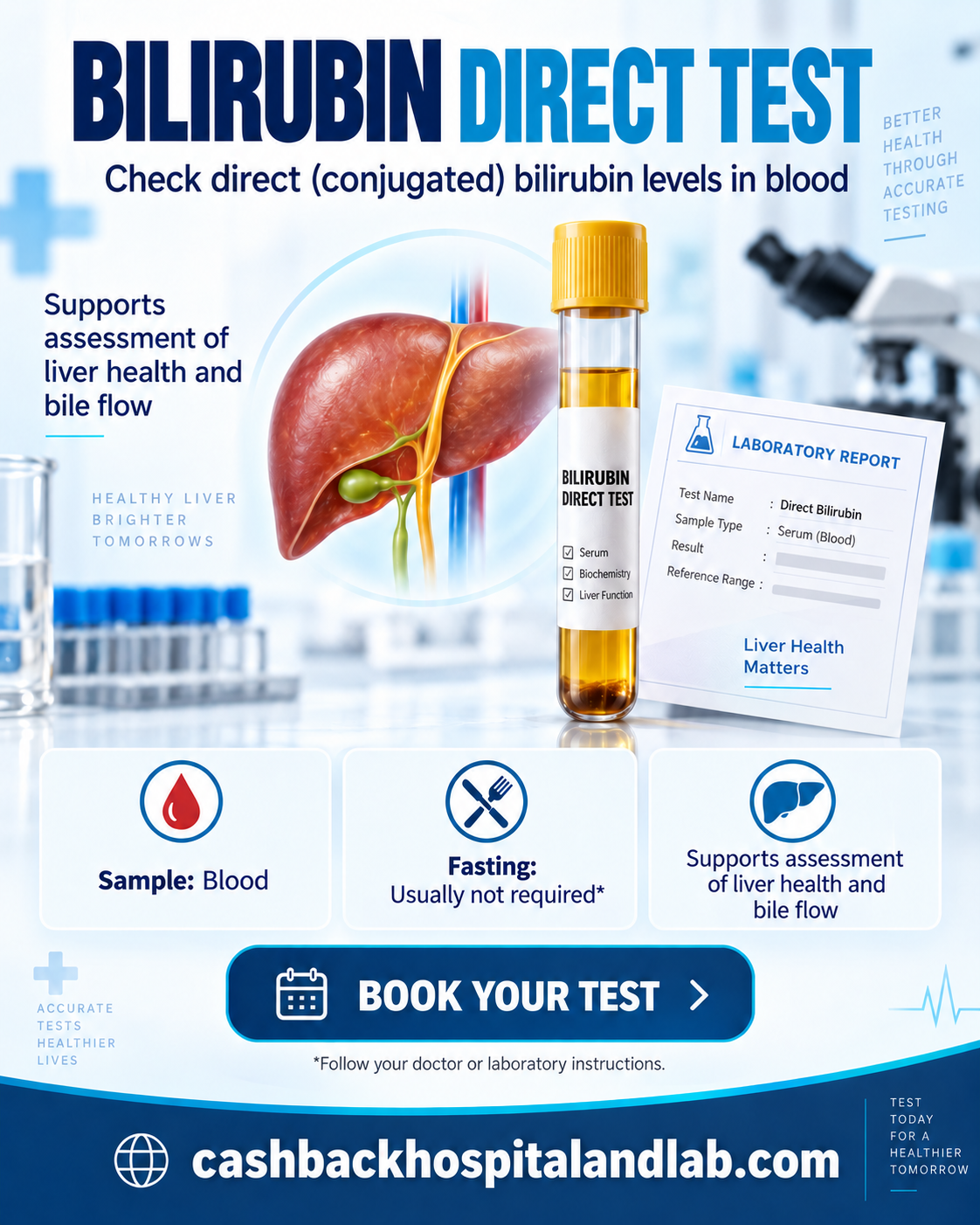
Direct Bilirubin (also known as Conjugated Bilirubin) is the water-soluble form of bilirubin processed by the liver. Bilirubin is a yellow byproduct created when the body breaks down old red blood cells. The liver converts indirect (unconjugated) bilirubin into direct bilirubin so it can be excreted via bile into the digestive tract.
| Product Price | ₹160.00 | ||
Click to add this item to cart. | |||
Product Description
Direct Bilirubin (also known as Conjugated Bilirubin) is the water-soluble form of bilirubin processed by the liver. Bilirubin is a yellow byproduct created when the body breaks down old red blood cells. The liver converts indirect (unconjugated) bilirubin into direct bilirubin so it can be excreted via bile into the digestive tract.
Purpose & Clinical Use
-
Evaluating Liver & Biliary Function: Helps determine whether jaundice (yellowing of skin/eyes) or liver dysfunction is caused by liver cell damage or a blockage in the bile ducts.
-
Diagnosing Cholestasis: Detects conditions where bile flow from the liver is slowed or blocked (such as gallstones, strictures, or tumors).
-
Part of a Liver Panel: Frequently measured alongside Total Bilirubin, Indirect Bilirubin, ALT, AST, and ALP to provide a complete picture of liver and gallbladder health.
Test Details
-
Specimen: Standard blood draw (Serum).
-
Preparation: Fasting for 4 hours prior to the test is typically required, especially when ordered as part of a full liver panel.
-
Calculation: Direct Bilirubin is subtracted from Total Bilirubin to calculate Indirect Bilirubin ($Total = Direct + Indirect$).
Interpreting Results
-
Normal Range: Typically
0.0 to 0.3 mg/dL(0 to 5.1 µmol/L), though reference ranges vary by laboratory. -
Elevated Direct Bilirubin (Conjugated Hyperbilirubinemia): Indicates that the liver successfully processed bilirubin, but it cannot escape into the intestines due to a duct obstruction or liver cell dysfunction. Common causes include:
-
Bile Duct Obstruction: Gallstones, pancreatic tumors, or biliary strictures.
-
Liver Injury: Hepatitis (viral or toxic), cirrhosis, or drug-induced liver toxicity.
-
Genetic Conditions: Dubin-Johnson syndrome or Rotor syndrome.
-


Review Bilirubin Direct.