
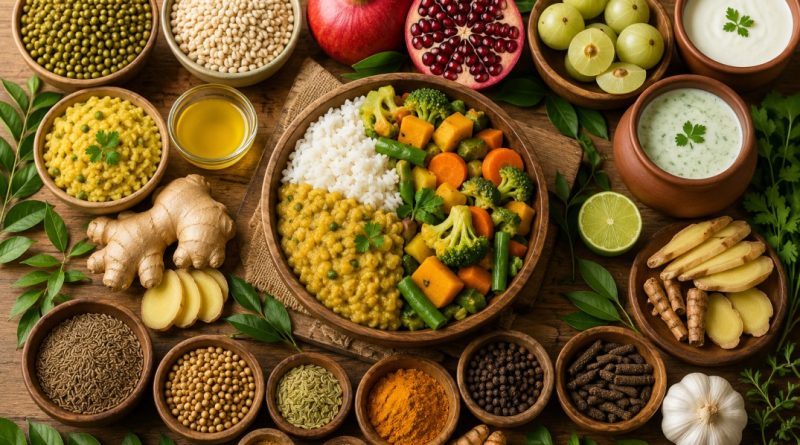
Ayurvedic Foods for Better Digestion
A Classical Ayurveda Guide to Agni, Ama, Pathya, Food Combining, Meal Timing & Digestive Health
Ayurveda places digestion at the centre of health. Rather than asking only what a person eats, classical Ayurvedic literature also considers how much is eaten, when it is eaten, how it is prepared, the individual's digestive capacity (Agni), season, constitution and compatibility of foods.
The central concept is Agni (अग्नि)—a traditional Ayurvedic framework encompassing digestion and transformation. Ayurveda teaches that even wholesome food may not be beneficial when digestion is impaired or when food is consumed inappropriately.
At the same time, Agni should not be equated literally with stomach acid, digestive enzymes or metabolic rate. It is a classical Ayurvedic concept rather than a single measurable modern physiological parameter.
1. Why Is Agni So Important in Ayurveda?
A foundational statement from Charaka Samhita, Chikitsa Sthana 15 says:
आयुर्वर्णो बलं स्वास्थ्यमुत्साहोपचयौ प्रभा।
ओजस्तेजोऽग्नयः प्राणाश्चोक्ता देहाग्निहेतुकाः॥
Meaning
Ayurveda describes life, complexion, strength, health, enthusiasm, nourishment, lustre, Ojas and other vital functions as being dependent upon properly functioning Dehagni.
This demonstrates how central digestion and transformation are to classical Ayurvedic physiology.
2. The Famous Ayurvedic Principle: Disease and Agni
Charaka further states:
शान्तेऽग्नौ म्रियते युक्ते चिरं जीवत्यनामयः।
रोगी स्याद्विकृते मूलमग्निस्तस्मान्निरुच्यते॥
Practical meaning
When Agni functions appropriately, Ayurveda associates it with health and longevity; disturbed Agni is considered an important contributor to disease.
This does not mean every modern disease is literally caused by poor digestion. It describes Ayurveda's traditional theoretical framework.
3. What Is Jatharagni?
Jatharagni (जाठराग्नि) refers primarily to the digestive Agni associated with gastrointestinal processing.
Ayurveda also describes broader levels of metabolic transformation, including:
Jatharagni
Primary digestion.
Bhutagni
Transformation associated with the five Mahabhutas.
Dhatvagni
Metabolic transformation associated with the Dhatus.
For practical dietary guidance, Jatharagni is particularly important.
4. Four Functional States of Agni
Ayurveda traditionally describes four important patterns.
Sama Agni — समाग्नि
Balanced digestion.
Traditionally associated with:
- Appropriate appetite
- Comfortable digestion
- Regular elimination
- General wellbeing
Manda Agni — मन्दाग्नि
Sluggish digestive capacity, traditionally associated particularly with Kapha.
Possible complaints may include heaviness, low appetite and slow digestion.
Tikshna Agni — तीक्ष्णाग्नि
Intense digestive activity, traditionally associated particularly with Pitta.
People may describe excessive hunger, burning or intolerance of delayed meals.
Vishama Agni — विषमाग्नि
Irregular digestion, traditionally associated particularly with Vata.
Symptoms may fluctuate and can include irregular appetite, bloating and variable bowel habits.
These categories are Ayurvedic patterns and should not replace medical diagnosis.
5. What Is Ama?
Ama (आम) is an important classical Ayurvedic concept associated with incomplete processing or digestion.
It is commonly described in contemporary Ayurveda using ideas such as:
- Heaviness
- Coated tongue
- Poor appetite
- Digestive discomfort
- Sluggishness
However:
Ama should not simply be translated as “toxins.”
There is no scientifically established blood test demonstrating that the classical Ayurvedic concept of Ama represents a particular chemical toxin.
6. The First Rule: Eat According to Agni
Ayurveda does not necessarily consider a food universally good simply because it is nutritious.
Food should also be appropriate to the individual's:
Agni + Satmya + Prakriti + Vikriti + age + season + activity + health condition.
Someone tolerating a food well may respond differently from another person with a gastrointestinal disorder.
7. The Eight Factors of Food – Ashta Ahara Vidhi Visheshayatana
Charaka Samhita, Vimanasthana 1 describes eight important factors affecting food:
प्रकृतिकरणसंयोगराशिदेशकालोपयोगसंस्थोपयोक्तारश्चाष्टावाहारविधिविशेषायतनानि भवन्ति।
These are:
1. Prakriti – प्रकृति
Natural qualities of the food.
2. Karana – करण
Processing or preparation.
3. Samyoga – संयोग
Food combinations.
4. Rashi – राशि
Quantity.
5. Desha – देश
Region/environment.
6. Kala – काल
Time and season.
7. Upayoga-Samstha – उपयोगसंस्था
Rules governing consumption.
8. Upayokta – उपयोक्ता
The person eating the food.
This is one of Ayurveda's most sophisticated dietary principles:
The eater matters as much as the food.
8. Classical Rules for Eating
Charaka describes several principles for healthy eating, traditionally summarized as:
उष्णमश्नीयात्। स्निग्धमश्नीयात्। मात्रावदश्नीयात्।
जीर्णेऽश्नीयात्। वीर्याविरुद्धमश्नीयात्...
The broader classical guidance includes eating food that is:
- Appropriately warm
- Suitably unctuous
- In an appropriate quantity
- Consumed after the previous meal has been digested
- Compatible
- Eaten in a suitable place
- Not eaten excessively quickly
- Not eaten excessively slowly
- Consumed attentively
This remains one of the most practically useful parts of Ayurvedic nutrition.
9. Ushnam Ashniyat – Eat Fresh, Appropriately Warm Food
Ayurveda traditionally favours appropriately warm, freshly prepared food for many individuals.
Warm cooked foods may also be easier for some people to tolerate when they have:
- Poor appetite
- Bloating
- Gastrointestinal sensitivity
However, Ayurveda does not mean that every food must be extremely hot.
Excessively hot food can burn the mouth and oesophagus.
10. Snigdham Ashniyat – Appropriate Unctuousness
Snigdha refers to an unctuous or lubricating quality.
Traditionally, suitable amounts of fats such as Ghrita (ghee) or oils may be incorporated according to the individual.
Dietary fat also has important physiological roles, including helping absorb fat-soluble vitamins.
But:
“Ayurveda recommends ghee” does not mean unlimited ghee is healthy.
Quantity matters, particularly for people who need to manage overall energy intake or cardiovascular risk factors.
11. Matravat Ashniyat – Eat the Right Quantity
Ayurveda strongly emphasizes Matra, or quantity.
Overeating may contribute to:
- Fullness
- Reflux
- Bloating
- Sleepiness
- Gastrointestinal discomfort
Severe restriction is also undesirable.
The appropriate amount depends on the person, food and circumstances.
12. The Classical Stomach-Filling Principle
Ayurvedic teaching traditionally discourages completely overfilling the stomach.
The practical message is straightforward:
Eat enough to feel satisfied without becoming painfully full.
Modern digestive advice similarly recognizes that very large meals can worsen reflux, fullness and dyspepsia in susceptible people.
13. Eat After the Previous Meal Is Digested
Ayurveda emphasizes Jirne Ashniyat—eating after the previous food has been adequately processed.
This traditionally involves looking for genuine appetite rather than eating continuously.
It does not mean everyone must follow a rigid fasting schedule.
People with diabetes, pregnancy, eating disorders, certain medications or other medical conditions may require individualized meal timing.
14. Hunger Matters
Ayurveda distinguishes natural appetite from eating simply because:
- Food is visible
- You're bored
- You're stressed
- You're scrolling
- Everyone else is eating
Learning to recognize hunger and comfortable fullness can be useful.
But persistent appetite loss should not automatically be treated with digestive spices; it may require medical assessment.
15. Moong Dal – Mudga
Mudga (मुद्ग), commonly identified with green gram/moong, is highly valued in Ayurvedic dietary traditions.
It is frequently used in light meals because it is generally considered comparatively easy to digest when properly prepared.
Moong can provide:
- Plant protein
- Fibre
- Folate
- Minerals
- Complex carbohydrates
Practical use:
Moong dal + rice/whole grain + cooked vegetables
can form a balanced meal.
16. Khichdi
Khichdi has become almost synonymous with “Ayurvedic food,” but it should not be treated as magical.
A simple combination of:
Rice + moong dal + suitable spices + vegetables
can be:
- Soft
- Convenient
- Easily portioned
- Nutritious
- Comfortable during temporary digestive sensitivity
However, a healthy person does not need to live on khichdi.
Dietary variety remains important.
17. Rice – Shali
Classical Ayurveda describes several varieties of rice, including Shali.
Rice can be a useful source of carbohydrate and is often well tolerated.
For people requiring greater fibre or glycaemic control, portion size and the overall meal composition matter.
Combining rice with:
Dal + vegetables + protein + appropriate fat
creates a more nutritionally complete meal.
18. Barley – Yava
Yava (यव), or barley, is frequently mentioned in classical Ayurvedic literature.
Modern nutrition recognizes barley as a useful source of fibre, particularly beta-glucan.
It can contribute to:
- Fibre intake
- Satiety
- Bowel regularity
- Cardiometabolic nutrition
People with celiac disease must avoid barley because it contains gluten.
19. Amla – Amalaki
Amalaki (आमलकी) is one of Ayurveda's best-known fruits.
It is traditionally valued in multiple dietary and Rasayana contexts.
Fresh amla provides:
- Vitamin C
- Polyphenols
- Fibre
- Other plant compounds
It can be incorporated into a balanced diet if tolerated.
20. Pomegranate – Dadima
Dadima (दाडिम), or pomegranate, is traditionally valued in Ayurvedic dietetics.
It provides:
- Polyphenols
- Fibre when edible portions are consumed
- Micronutrients
It can be a useful fruit option within a varied diet.
Claims that pomegranate cures all digestive diseases, however, should be avoided.
21. Ginger – Shunthi/Ardraka
Ayurveda uses ginger in different forms:
Ardraka (आर्द्रक) – fresh ginger
Shunthi (शुण्ठी) – dried ginger
Ginger is widely used to support digestion and is also studied in modern medicine, particularly for nausea.
Small culinary amounts are sufficient for most people.
More is not necessarily better.
22. Classical Pre-Meal Ginger Practice
A traditional Ayurvedic dietary practice recommends a small amount of ginger with salt before eating in appropriate individuals to stimulate appetite and digestion.
This should be individualized.
People with:
- Significant reflux
- Gastritis symptoms
- Salt restriction
- Oral irritation
may not tolerate or require this practice.
23. Cumin – Jeeraka
Jeeraka (जीरक) is widely used in Indian cooking and Ayurvedic dietary practice.
Cumin can make food flavourful without requiring excessive sauces or sugar.
It is often incorporated into meals containing:
- Dal
- Vegetables
- Rice
- Soups
- Buttermilk
Culinary use is generally more sensible than assuming concentrated cumin products cure gastrointestinal diseases.
24. Coriander – Dhanyaka
Dhanyaka (धान्यक)—coriander—is another traditional culinary digestive herb.
Both seeds and leaves are commonly consumed.
It can be used in:
- Dal
- Vegetables
- Soups
- Chutneys
- Rice dishes
Its value should be considered within the whole diet rather than as a standalone digestive cure.
25. Fennel – Shatapushpa/Mishreya Traditions
Fennel is commonly used after meals in Indian dietary traditions.
It may help some people with subjective digestive comfort.
Chewing a small amount of plain fennel after food is different from consuming sugar-coated fennel mixtures in large quantities.
26. Ajwain
Ajwain is traditionally used for digestive discomfort and is a familiar household spice.
It may be incorporated into food in modest quantities.
But severe or recurrent abdominal pain should never simply be repeatedly treated with ajwain.
Persistent pain requires diagnosis.
27. Turmeric – Haridra
Haridra (हरिद्रा) is one of Ayurveda's most widely used herbs and an important culinary spice.
Turmeric contains curcuminoids and other compounds studied for biological activity.
For routine health:
Using turmeric as part of normal cooking is reasonable.
High-dose supplements are a different matter and may interact with medications or cause adverse effects.
28. Buttermilk – Takra
Takra (तक्र) has an important place in classical Ayurvedic dietetics.
A well-known verse praises it highly:
न तक्रसेवी व्यथते कदाचित्
न तक्रदग्धाः प्रभवन्ति रोगाः...
Traditional literature attributes several digestive benefits to properly prepared Takra.
Modern interpretation should remain cautious: buttermilk is a food, not a universal cure.
People with dairy allergy or intolerance may need to avoid it.
29. How to Use Takra Practically
Traditional Takra is not necessarily identical to commercially sweetened packaged buttermilk.
A practical preparation may involve:
- Plain cultured curd/yogurt
- Water
- Churning
- Appropriate seasoning
Depending on individual tolerance, small amounts of:
- Roasted cumin
- Coriander
- Other culinary spices
may be added.
Avoid turning it into a high-salt drink.
30. Curd – Dadhi
Ayurveda has detailed rules surrounding Dadhi (curd/yogurt).
Classical texts do not treat it as universally appropriate at all times.
Traditional considerations include:
- Season
- Individual constitution
- Digestive capacity
- Accompanying foods
- Time of consumption
From a modern perspective, plain yogurt can provide protein, calcium and live cultures depending on the product.
Individual tolerance remains important.
31. Is Curd at Night Forbidden?
Ayurvedic literature traditionally places restrictions on curd consumption under certain circumstances, particularly at night.
Modern evidence does not establish that yogurt eaten at night is inherently harmful to every healthy person.
Therefore, this is best presented as a traditional Ayurvedic dietary rule, rather than a universal scientific prohibition.
32. Ghee – Ghrita
Ghrita (घृत) has an important role in Ayurvedic food and medicine.
In cooking, modest amounts can improve:
- Palatability
- Energy density
- Absorption of fat-soluble nutrients
But ghee is rich in saturated fat and calories.
Therapeutic respect for Ghrita does not justify unlimited consumption.
33. Cooked Vegetables
For people experiencing temporary digestive sensitivity, cooked vegetables may sometimes be more comfortable than very large amounts of raw vegetables.
Useful options can include:
- Bottle gourd
- Pumpkin
- Carrots
- Spinach and leafy vegetables
- Zucchini
- Beans
- Other seasonal vegetables
Selection should reflect individual tolerance.
34. Fruit and Digestion
Whole fruits provide:
- Fibre
- Vitamins
- Minerals
- Water
- Polyphenols
Useful choices include:
- Amla
- Guava
- Papaya
- Pomegranate
- Apples
- Oranges
- Berries where available
- Seasonal local fruits
Whole fruit is generally preferable to routinely drinking large quantities of fruit juice.
35. Is Papaya a Digestive Medicine?
Papaya contains enzymes such as papain and is a nutritious fruit.
But it should not be advertised as a treatment that “cleans the intestines” or cures all constipation.
Its main nutritional value comes from being part of a fibre-rich, varied diet.
36. Fibre: A Modern Addition to Digestive Health
Modern evidence strongly supports adequate dietary fibre.
Sources include:
- Vegetables
- Fruits
- Pulses
- Beans
- Whole grains
- Nuts
- Seeds
Fibre supports bowel function and the gut microbiome.
Increase fibre gradually if your current intake is low because sudden large increases may worsen gas and bloating.
37. Gut Microbiome and Ayurveda
It is tempting to claim that Agni = microbiome, but that is inaccurate.
The gut microbiome refers to microorganisms living within the gastrointestinal tract.
Agni is a broader Ayurvedic concept of digestion and transformation.
There may be interesting areas for research between traditional dietary patterns and microbiome science, but the two terms should not be treated as synonyms.
38. Viruddha Ahara – Incompatible Food
Ayurveda describes Viruddha Ahara (विरुद्ध आहार)—foods or combinations considered incompatible according to classical principles.
Charaka discusses multiple forms of incompatibility involving factors such as:
- Desha
- Kala
- Agni
- Matra
- Satmya
- Samskara
- Virya
- Combination
This is considerably more nuanced than internet lists saying “never mix these two foods.”
39. Milk and Fish
Milk with fish is one of the most frequently discussed examples in Ayurvedic food-combination literature.
From a classical perspective, certain such combinations are considered Viruddha.
From a modern scientific perspective, there is no general evidence that eating fish and dairy together creates a universal toxin in healthy people.
So it is appropriate to distinguish:
Classical Ayurvedic rule from scientifically established food toxicity.
40. Fruit With Meals
Online claims sometimes say Ayurveda absolutely prohibits all fruit with other foods.
Classical food-combination principles are more complex.
From a modern nutritional perspective, most healthy people can safely consume fruit as part of a mixed meal.
People with individual gastrointestinal sensitivity can adjust timing based on tolerance.
41. Honey – Madhu
Honey has a significant place in Ayurvedic literature.
One particularly important traditional warning concerns heating honey.
Classical Ayurveda generally discourages heated honey.
Modern science does not establish that ordinary culinary heating transforms honey into a unique systemic “toxin” in the exact Ayurvedic sense.
Therefore, again, distinguish traditional guidance from proven toxicology.
Honey also remains free sugar, so excessive consumption is undesirable.
42. Water With Meals
MYTH:
“Never drink water while eating.”
FACT:
Small amounts of water during meals are generally acceptable.
Drinking water does not simply extinguish digestive enzymes.
Very large quantities may make some people uncomfortable, but normal hydration around meals is reasonable.
43. Ice-Cold Water
Ayurveda commonly prefers warmer or room-temperature fluids in people with weaker digestion.
Some individuals with dyspepsia may indeed find very cold drinks uncomfortable.
However, cold water does not universally “destroy Agni” in a measurable biomedical sense.
Choose a temperature you tolerate comfortably.
44. Eat Mindfully
One of the most valuable classical principles is paying attention while eating.
Try to:
- Sit down
- Slow down
- Chew adequately
- Notice hunger
- Notice fullness
- Reduce unnecessary distractions
Watching short videos while rapidly eating may make it easier to overlook satiety signals.
45. Don't Eat Too Fast
Eating extremely quickly may contribute to:
- Overeating
- Fullness
- Indigestion
- Reduced awareness of satiety
Ayurveda specifically cautions against eating excessively quickly.
A calmer pace is reasonable both traditionally and practically.
46. Don't Eat Excessively Slowly
Interestingly, classical Ayurveda also cautions against eating excessively slowly.
The broader lesson is moderation and attention, rather than rigid timing with a stopwatch.
47. Meal Timing
Regular meal timing can help many people establish predictable appetite patterns.
A practical framework might be:
Breakfast: according to appetite and schedule
Lunch: substantial balanced meal
Dinner: appropriately portioned and not excessively close to bedtime
Individual requirements differ.
48. Should Lunch Be the Biggest Meal?
Ayurvedic tradition often gives importance to daytime digestion.
A substantial nutritious lunch may work well for many people.
However, meal distribution should also reflect:
- Work schedule
- Exercise
- Diabetes management
- Medication timing
- Personal tolerance
There is no single meal schedule suitable for every person.
49. Dinner for Better Digestion
For people troubled by reflux, heaviness or disturbed sleep, it may help to:
- Avoid extremely large dinners
- Reduce very fatty meals
- Avoid lying down immediately after eating
- Leave adequate time before bedtime
This aligns reasonably well with both practical Ayurveda and modern digestive advice.
50. Foods That May Worsen Digestive Symptoms
Depending on the individual, problems may arise from excessive:
- Deep-fried food
- Ultra-processed food
- Alcohol
- Sugary beverages
- Very large meals
- Excessive chilli
- High-fat meals
- Certain fermentable carbohydrates
But trigger foods vary considerably.
Do not unnecessarily eliminate entire food groups without reason.
51. A Simple Ayurvedic Digestive Plate
A practical balanced meal might contain:
½ plate
Cooked or raw vegetables according to tolerance
¼ plate
Protein such as dal, beans, paneer, eggs, fish or another appropriate source
¼ plate
Rice, roti, barley or another whole-grain/starchy food
Plus:
- Appropriate healthy fat
- Herbs and spices
- Water according to thirst
This combines traditional dietary thinking with modern nutritional balance.
52. Example Breakfasts
Depending on appetite:
- Vegetable poha + protein source
- Oats + nuts + fruit
- Moong chilla + vegetables
- Idli + sambar
- Dalia + vegetables
- Eggs + whole-grain roti + vegetables
The goal is not to make every breakfast “detoxifying.”
It is to make it nutritious and tolerable.
53. Example Lunch
A balanced Indian lunch could include:
Dal
- vegetable sabzi
- roti or rice
- salad/cooked vegetables
- plain curd or Takra if tolerated
This is often more useful than relying on expensive “Ayurvedic superfoods.”
54. Example Light Dinner
Depending on needs:
Moong dal khichdi + vegetables
or
Dal + cooked vegetables + small grain portion
or
Soup + appropriate protein + whole grain
A light dinner should still provide adequate nutrition.
“Light” should not mean nutritionally deficient.
55. Deepana and Pachana
Ayurvedic treatment uses two important concepts:
Deepana – दीपन
Traditionally intended to stimulate or support Agni.
Pachana – पाचन
Traditionally intended to support processing of Ama.
Herbs and spices may be selected accordingly by practitioners.
These therapeutic concepts should not be translated into claims that a spice “burns toxins” unless evidence exists.
56. Common Deepana-Pachana Ingredients
Traditional practice may use ingredients such as:
- Shunthi
- Pippali
- Maricha
- Jeeraka
- Ajwain
- Hing
- Coriander
But medicinal doses differ from culinary use.
People taking medications, pregnant individuals and those with gastrointestinal disease should not self-prescribe concentrated herbal combinations casually.
57. Trikatu
Trikatu traditionally combines:
Shunthi + Maricha + Pippali
It is used within Ayurveda for selected indications.
However, Trikatu is not a universal daily digestive supplement.
It may be inappropriate for people experiencing:
- Significant reflux
- Burning
- Gastritis-like symptoms
- Certain medication interactions
Individual assessment matters.
58. Hing – Hingu
Asafoetida or Hingu is traditionally used in digestive formulations and cooking.
Adding a small amount while preparing pulses may improve flavour and is commonly used by people who find legumes gas-producing.
Therapeutic doses should not be assumed to be universally appropriate.
59. Triphala and Constipation
Triphala is commonly marketed as a daily “detox.”
That description is misleading.
It has traditional gastrointestinal uses and may affect bowel function, but persistent constipation should first be addressed through:
- Fibre
- Fluids
- Activity
- Toilet habits
- Medication review
- Appropriate diagnosis
Long-term self-treatment should not mask underlying disease.
60. Ayurveda Does Not Require “Detoxing” Every Week
A healthy digestive routine does not require:
- Weekly purgation
- Juice cleanses
- Extreme fasting
- Daily laxatives
- Forced vomiting
- Unsupervised Panchakarma
Aggressive cleansing can cause:
- Dehydration
- Electrolyte disturbance
- Nutritional problems
- Medication-related complications
Classical Panchakarma is a therapeutic system requiring proper selection and supervision—not a social-media detox challenge.
Ayurvedic Digestion: Myths vs Facts
| MYTH | MORE ACCURATE VIEW |
|---|---|
| Agni is exactly stomach acid | Agni is a broader classical Ayurvedic concept |
| Ama is a measurable chemical toxin | No single biomedical marker represents classical Ama |
| Everyone needs hot water | Fluid temperature can be individualized |
| Khichdi cures every digestive problem | It can be a convenient, gentle meal |
| Ghee can be eaten without limits | Quantity and overall diet matter |
| Every person should take Trikatu | Therapeutic herbs require individualization |
| Oil pulling detoxifies digestion | Its plausible effects are primarily oral |
| Fruit should never accompany meals | Most healthy people tolerate mixed meals |
| Every food-combination rule is scientifically proven | Classical and modern evidence should be distinguished |
| More spices mean stronger Agni | Excessive spices may worsen symptoms |
| Daily purgation removes Ama | Unnecessary purgation can be harmful |
| All bloating means weak Agni | Bloating has many possible medical causes |
Foods Commonly Useful in an Ayurvedic-Inspired Digestive Diet
| Food | Ayurvedic Context | Modern Nutritional Value |
|---|---|---|
| Moong | Traditionally light | Protein + fibre |
| Rice | Common digestible staple | Carbohydrate |
| Barley | Classical grain | Beta-glucan fibre |
| Amla | Rasayana food | Vitamin C + polyphenols |
| Pomegranate | Traditional Pathya food | Fibre + polyphenols |
| Ginger | Deepana/Pachana use | Studied particularly for nausea |
| Cumin | Digestive culinary spice | Flavour + plant compounds |
| Coriander | Traditional culinary herb | Phytonutrients |
| Turmeric | Major Ayurvedic spice | Curcuminoids |
| Takra | Classical digestive food | Fermented dairy nutrients |
| Vegetables | Dietary variety | Fibre + micronutrients |
| Fruits | Individualized by Ayurveda | Fibre + vitamins |
When Digestive Symptoms Need Medical Attention
Do not assume every gastrointestinal symptom is merely “weak Agni.”
Seek medical assessment for:
- Blood in stool
- Black, tarry stool
- Persistent vomiting
- Difficulty swallowing
- Severe abdominal pain
- Unexplained weight loss
- Persistent diarrhoea
- Persistent constipation with concerning symptoms
- Anaemia
- Fever with abdominal symptoms
- Jaundice
- New persistent symptoms later in life
These may require investigation rather than digestive herbs alone.
The Best Practical Formula
For most people, a sensible Ayurvedic-inspired approach can be simplified to:
Eat when appropriately hungry
↓
Choose mostly fresh, minimally processed food
↓
Use vegetables, pulses, whole grains and suitable protein
↓
Use culinary digestive spices according to tolerance
↓
Eat an appropriate quantity
↓
Eat calmly and attentively
↓
Avoid habitual overeating
↓
Maintain regular physical activity
↓
Allow adequate sleep and recovery
↓
Support Agni Through Consistency Rather Than Extreme “Detox”
Classical Ayurveda + Modern Nutrition
The strongest way to use Ayurvedic nutrition today is not to choose between ancient and modern knowledge.
Classical Ayurveda contributes valuable concepts such as:
Agni • Matra • Satmya • Kala • Prakriti • Karana • Samyoga • mindful eating • individualization
Modern nutritional science contributes:
Protein • fibre • micronutrients • energy balance • microbiome science • food safety • disease-specific nutrition
Used thoughtfully, these perspectives can complement each other without claiming that ancient concepts and modern biological mechanisms are identical.
Conclusion
Classical Ayurveda does not reduce digestive health to drinking hot water or consuming a particular spice.
Its dietary literature presents a much broader principle:
The right food + right quantity + right preparation + right timing + right combination + right person.
The teachings of Agni, Ashta Ahara Vidhi Visheshayatana, Matra, Satmya and Viruddha Ahara demonstrate that Ayurveda viewed eating as an individualized process rather than simply categorizing foods as “good” or “bad.”
For everyday digestive health, a practical approach is:
Fresh food + adequate fibre + appropriate protein + vegetables + fruits + whole grains/pulses + sensible spices + appropriate portions + regular movement + adequate sleep.
Traditional foods such as Mudga (moong), Shali, Yava, Dadima, Amalaki and Takra, along with culinary herbs such as Shunthi, Jeeraka, Dhanyaka and Haridra, can form part of that approach when appropriate for the individual.
Most importantly:
Ayurveda asks not only “What are you eating?” but also “Can you digest it appropriately?”
That remains one of the most useful principles of Ayurvedic dietetics.
Disclaimer: This article is educational and does not replace individualized medical or dietetic advice. Persistent or severe digestive symptoms require appropriate medical evaluation. Therapeutic Ayurvedic herbs and Panchakarma procedures should be used under appropriately qualified supervision.
cashbackhospitalandlab.com