
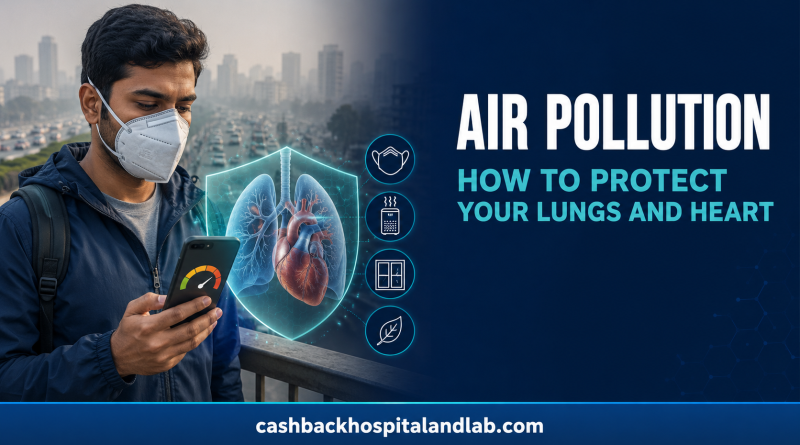
Air Pollution: How to Protect Your Lungs and Heart
Air pollution is not only a problem for the lungs. Fine particles and harmful gases in polluted air can affect the heart, blood vessels, brain and other organs, making air pollution an important public-health concern.
The risk becomes particularly important during periods of severe smog, wildfire smoke, traffic pollution, industrial emissions and high Air Quality Index (AQI) readings.
People often ask whether masks, air purifiers, indoor plants or supplements can protect them. Some measures genuinely reduce exposure, while others offer much less protection than advertising suggests.
The practical goal is simple:
Know when pollution is high, reduce unnecessary exposure, improve indoor air quality and take extra precautions if you are at higher risk.
What Is Air Pollution?
Air pollution is a mixture of particles and gases present in the air at concentrations that can harm health.
Important pollutants include:
- Particulate matter (PM2.5 and PM10)
- Nitrogen dioxide (NO₂)
- Ozone
- Sulfur dioxide (SO₂)
- Carbon monoxide
- Smoke
- Various chemical pollutants
The type and concentration of pollutants vary according to location, season, weather and pollution source.
What Is PM2.5?
PM2.5 refers to particulate matter with an aerodynamic diameter of approximately 2.5 micrometres or smaller.
These particles are extremely small.
Major sources can include:
- Vehicle exhaust
- Coal and industrial combustion
- Biomass burning
- Crop-residue burning
- Wildfires
- Construction-related pollution
- Household fuel combustion
Because PM2.5 particles are so small, they can penetrate deeply into the lungs.
Why Is PM2.5 Particularly Important?
Larger particles are more likely to become trapped in the nose and upper respiratory tract.
Fine particles can travel much deeper into the respiratory system.
Exposure can contribute to:
- Airway irritation
- Inflammation
- Worsening asthma
- Cardiovascular stress
Long-term exposure is associated with increased risks of serious cardiovascular and respiratory disease.
What Is PM10?
PM10 refers to inhalable particles approximately 10 micrometres or smaller.
Sources may include:
- Road dust
- Construction
- Soil
- Industrial activity
- Combustion
PM10 is also relevant to respiratory health, although PM2.5 generally receives particular attention because of its ability to penetrate deeply into the lungs.
Air Pollution Doesn’t Only Damage the Lungs
It is easy to assume that polluted air causes only:
- Cough
- Wheezing
- Asthma
But air pollution can also affect the cardiovascular system.
Fine-particle exposure can promote processes involving:
- Inflammation
- Oxidative stress
- Blood-vessel dysfunction
- Autonomic nervous-system changes
These effects help explain why air pollution is associated with cardiovascular events.
Air Pollution and Heart Disease
Exposure to particulate pollution is associated with increased cardiovascular risk.
This includes higher risks of:
- Heart attack
- Stroke
- Heart failure
- Abnormal heart rhythms
- Cardiovascular death
Risk is particularly important among people who already have cardiovascular disease.
This is why severe pollution alerts should not be treated as merely an inconvenience for people with asthma.
Air Pollution and Blood Pressure
Air pollution exposure can influence blood-vessel function and autonomic regulation.
Short-term increases in pollution may contribute to changes in:
- Blood pressure
- Heart rate
- Vascular function
People with hypertension should continue taking prescribed medication and pay additional attention to exposure during severe pollution episodes.
Air Pollution and Stroke
Long-term and short-term exposure to air pollution has been associated with increased stroke risk.
Protecting cardiovascular health therefore includes reducing unnecessary exposure to polluted air where practical.
Traditional cardiovascular prevention remains essential:
- Control blood pressure
- Control cholesterol
- Manage diabetes
- Avoid smoking
- Exercise appropriately
- Maintain a nutritious diet
Pollution reduction complements these measures rather than replacing them.
Air Pollution and Asthma
Polluted air can irritate the airways and trigger asthma symptoms such as:
- Cough
- Wheezing
- Chest tightness
- Shortness of breath
People with asthma should have an appropriate treatment plan and know how to use prescribed inhalers correctly.
Pollution is not a reason to discontinue regular controller medication.
Air Pollution and COPD
People with chronic obstructive pulmonary disease (COPD) can be particularly vulnerable.
Pollution may worsen:
- Breathlessness
- Cough
- Wheezing
- Exercise tolerance
Severe or rapidly worsening breathing difficulty requires medical attention.
Can Air Pollution Cause Lung Cancer?
Long-term exposure to outdoor air pollution is associated with lung cancer risk.
However, individual cancer risk depends on many factors.
The most important preventable lung-cancer risk remains tobacco exposure.
A person should not become so focused on outdoor pollution that they overlook smoking or secondhand smoke.
Who Is Most Vulnerable?
Air pollution can affect everyone, but some groups require greater caution.
These include:
- Children
- Older adults
- Pregnant people
- People with asthma
- People with COPD
- People with heart disease
- People with previous stroke
- People with diabetes
- Outdoor workers
- People exercising heavily outdoors
Risk depends on both pollutant concentration and duration of exposure.
Children and Air Pollution
Children may be particularly vulnerable because:
- Their lungs are still developing.
- They often spend substantial time being physically active outdoors.
- They breathe more air relative to their body size than adults.
During severe pollution, outdoor activity may need to be reduced or moved indoors.
Children with asthma require particular attention.
Older Adults
Older adults are more likely to have underlying:
- Cardiovascular disease
- Lung disease
- Diabetes
that can increase vulnerability to pollution.
During very poor air quality, avoiding unnecessary outdoor exposure can be especially important.
Pregnancy and Air Pollution
Research has associated air-pollution exposure during pregnancy with adverse pregnancy outcomes.
Pregnant individuals should follow local air-quality advice and reduce unnecessary exposure during severe pollution events.
This does not mean remaining indoors permanently.
The objective is sensible exposure reduction when pollution levels are particularly high.
What Is the Air Quality Index (AQI)?
The Air Quality Index converts measurements of air pollutants into a scale designed to communicate how polluted the air is and the potential health implications.
AQI systems vary between countries.
This is important because an AQI value from one country’s system may not correspond exactly to the same number in another system.
Always interpret AQI using the health categories provided by your local air-quality authority.
AQI Is a Practical Decision Tool
Rather than guessing based on whether the sky looks hazy, check reliable air-quality information.
Depending on the AQI and your health status, you may decide to:
- Exercise outdoors normally
- Reduce prolonged outdoor exercise
- Move exercise indoors
- Wear an appropriate respirator outdoors
- Improve indoor filtration
- Keep vulnerable people indoors more often
The worse the air quality, the more aggressive exposure reduction should become.
Can You Trust What the Air Looks Like?
Not always.
Severe smog may be clearly visible.
But harmful particulate pollution can also be present when the air does not look dramatically dirty.
Likewise, fog and humidity can sometimes make the air appear worse without telling you the exact pollutant concentration.
Use actual air-quality monitoring when available.
Should You Exercise When Pollution Is High?
Exercise increases breathing rate and the amount of air inhaled.
This means strenuous outdoor exercise during severe pollution can increase pollutant exposure.
When air quality is poor, consider:
- Reducing exercise intensity
- Shortening outdoor sessions
- Exercising indoors
- Choosing a cleaner location
- Exercising when pollution levels are lower
However, physical inactivity also harms health.
The goal is not to stop exercising—it is to exercise more intelligently during pollution episodes.
Is Morning Exercise Always Better?
Not necessarily.
Pollution levels can vary substantially throughout the day.
In some locations and seasons, early morning conditions may trap pollutants close to the ground.
Instead of assuming that 5 or 6 a.m. is always safest, check local air-quality conditions.
Traffic Pollution
Roads with heavy traffic can expose pedestrians, cyclists and roadside workers to higher concentrations of:
- Fine particles
- Nitrogen dioxide
- Other traffic-related pollutants
When practical, choose walking or cycling routes away from major roads.
Even moving to a quieter parallel street may reduce exposure.
Outdoor Workers
People working outdoors may have limited ability to avoid polluted air.
Examples include:
- Construction workers
- Traffic police
- Delivery workers
- Street vendors
- Agricultural workers
- Drivers
Workplace strategies can include:
- Monitoring air quality
- Reducing strenuous activity during severe pollution
- Taking breaks in cleaner indoor environments
- Using appropriate respiratory protection when indicated
Occupational protection should not depend solely on individual workers purchasing masks themselves.
Do Masks Protect Against Air Pollution?
The answer depends on the mask.
A well-fitting particulate respirator such as:
N95, KN95 or equivalent
can substantially reduce inhalation of airborne particles when it fits properly and is worn correctly.
However, no mask provides perfect protection.
Surgical Masks vs N95 Respirators
Loose surgical or cloth masks are not designed to filter fine particles as effectively as a properly fitted particulate respirator.
For significant PM2.5 exposure:
A well-fitting N95/KN95-type respirator generally provides substantially better particle filtration.
Fit is crucial.
Air leaking around the sides reduces protection.
Masks Do Not Filter Every Pollutant
Particulate respirators are designed primarily to filter particles.
They do not necessarily provide adequate protection against all:
- Gases
- Vapours
- Carbon monoxide
This is why a respirator should not be viewed as permission to remain unnecessarily in a heavily polluted environment.
Reducing exposure remains the priority.
How to Improve Mask Fit
A respirator should:
- Cover the nose and mouth completely
- Fit closely against the face
- Have minimal gaps around the edges
- Be comfortable enough to wear correctly
Facial hair can interfere with the seal of tight-fitting respirators.
A high-quality respirator worn loosely may provide less protection than expected.
Can Children Wear N95 Masks?
Some children may be able to use appropriately sized high-filtration masks, but adult respirators may not fit children’s faces correctly.
Fit, comfort, age and ability to wear the mask safely matter.
The first strategy for children during severe pollution should still be reducing unnecessary exposure.
Do Air Purifiers Work?
Portable air cleaners equipped with appropriate HEPA filtration can reduce indoor particulate concentrations.
They can be particularly useful in:
- Bedrooms
- Living rooms
- Classrooms
- Offices
during periods of high outdoor particle pollution.
The purifier must be appropriately sized for the room.
What Is a HEPA Filter?
HEPA stands for High-Efficiency Particulate Air filtration.
HEPA filters are designed to capture a very high proportion of airborne particles.
For pollution protection, look beyond advertising terms such as:
- “Air detox”
- “Ion purification”
- “Fresh-air technology”
and focus on actual filtration performance.
What Is CADR?
CADR—Clean Air Delivery Rate—is a useful measure when selecting an air purifier.
It reflects how much filtered air the device can deliver.
A small purifier may not effectively clean a very large room.
Therefore, consider:
- Room size
- CADR
- Filter type
- Noise
- Replacement-filter cost
rather than choosing solely by brand or appearance.
Where Should You Put an Air Purifier?
For many households, the bedroom is a useful priority because people spend many hours there.
Keep the purifier:
- In the room being used
- Away from major airflow obstructions
- Operating long enough to clean the room
During severe pollution episodes, continuous operation may be useful depending on the device and indoor conditions.
Keep Doors and Windows Closed?
During severe outdoor pollution, closing windows and doors can help reduce infiltration of outdoor particles.
However, buildings also need appropriate ventilation.
When outdoor air improves, ventilation may be useful.
The practical strategy is:
Avoid bringing heavily polluted outdoor air inside unnecessarily, while maintaining safe indoor ventilation according to conditions.
Indoor Air Pollution Matters Too
Closing windows does not guarantee clean indoor air.
Indoor pollution sources include:
- Tobacco smoke
- Incense
- Mosquito coils
- Candles
- Cooking smoke
- Wood or biomass burning
- Poorly vented gas appliances
During outdoor pollution episodes, adding more indoor smoke can significantly worsen exposure.
Cooking and Indoor Air Quality
Cooking—particularly frying, grilling and high-temperature cooking—can generate fine particles.
Use:
- Kitchen exhaust fans
- Chimneys vented outdoors
- Appropriate ventilation
when possible.
A HEPA air purifier can help with particles but does not replace safe ventilation for combustion gases.
Incense and Dhoop
Incense and dhoop produce smoke and particulate matter.
“Natural” smoke is still smoke.
Frequent burning indoors can worsen indoor air quality, particularly for people with:
- Asthma
- COPD
- Other respiratory conditions
If air quality is already poor outdoors, minimizing additional indoor smoke is sensible.
Mosquito Coils
Burning mosquito coils can generate indoor pollutants.
Where practical, alternatives such as:
- Screens
- Nets
- Other appropriate mosquito-control methods
can reduce the need to create smoke indoors.
Secondhand Smoke
There is no safe reason to add tobacco smoke to an already polluted environment.
Avoid smoking indoors and around:
- Children
- Pregnant people
- Older adults
- People with heart or lung disease
Opening a window does not eliminate secondhand-smoke exposure.
Can Indoor Plants Clean the Air?
Indoor plants can improve appearance and may have psychological benefits.
But ordinary numbers of houseplants do not replace:
- HEPA filtration
- Source control
- Proper ventilation
for meaningful reduction of indoor PM2.5.
Do not rely on a few plants as your primary pollution-protection strategy.
Does Steam Inhalation Remove Pollution From the Lungs?
No.
Steam may temporarily soothe nasal or throat irritation for some people, but it does not:
wash PM2.5 out of the lungs.
Very hot steam can also cause burns.
There is no need to perform aggressive steam inhalation after pollution exposure.
Can Your Lungs “Detox” From Pollution?
The lungs have natural protective and clearance mechanisms.
There is no special juice, tea, supplement or herbal mixture proven to rapidly “detox” particulate pollution from the lungs.
The best strategy is to:
reduce further exposure and support overall respiratory and cardiovascular health.
Do Antioxidant Supplements Protect Against Pollution?
Pollution can contribute to oxidative stress, which has led to marketing claims involving antioxidant supplements.
However, there is no established supplement that allows someone to safely ignore severe pollution exposure.
A nutritious diet containing:
- Fruits
- Vegetables
- Legumes
- Nuts
- Seeds
is sensible for general health.
It should not be marketed as a substitute for cleaner air.
Vitamin C and Air Pollution
Vitamin C is an essential nutrient.
People should obtain adequate amounts through food or supplements when medically appropriate.
But megadoses of vitamin C have not been established as a shield against PM2.5 exposure.
Omega-3 and Air Pollution
Omega-3 fatty acids are being studied in relation to cardiovascular and inflammatory responses.
However, taking fish-oil capsules should not be considered a substitute for reducing pollution exposure.
Pollution protection begins with:
cleaner air, filtration and exposure reduction.
Hydration and Pollution
Staying adequately hydrated supports general health and may help with dry mouth or throat discomfort.
However:
drinking extra water does not flush PM2.5 out of your lungs.
Hydration is healthy, but it is not a pollution antidote.
Air Pollution and Exercise: Finding the Balance
Both air pollution and physical inactivity are harmful.
A practical approach during polluted periods is to move exercise to:
- An indoor gym with good filtration
- Home
- A cleaner part of the city
- A time when AQI is better
rather than abandoning exercise for weeks.
Protecting Your Heart During Pollution Episodes
People with cardiovascular disease should pay particular attention during severe pollution.
Useful measures include:
- Take prescribed medicines consistently.
- Avoid strenuous outdoor exertion when pollution is severe.
- Monitor symptoms.
- Reduce exposure to smoke.
- Maintain indoor filtration where possible.
- Follow local pollution alerts.
Do not change heart medication without medical advice.
Protecting Asthma Patients
People with asthma should:
- Continue prescribed controller treatment.
- Keep their reliever inhaler accessible if prescribed.
- Avoid known triggers.
- Reduce outdoor activity during severe pollution.
- Use an appropriate respirator when necessary.
- Follow their asthma action plan.
Increasing breathlessness despite usual treatment requires medical assessment.
When Should You Seek Medical Help?
Seek medical attention for symptoms such as:
- Persistent or worsening shortness of breath
- Significant wheezing
- Chest tightness that does not improve
- Severe coughing
- Reduced exercise tolerance
- Symptoms that are unusual for you
People with known heart or lung disease should have a lower threshold for seeking assessment.
Emergency Warning Signs
Seek urgent emergency medical care for:
- Severe difficulty breathing
- Blue or grey lips
- New severe chest pain or pressure
- Fainting
- Severe confusion
- Signs of stroke
- Sudden severe weakness
- Inability to speak normally because of breathlessness
Do not assume serious chest symptoms are “just pollution.”
Air Pollution Myths vs Facts
| Myth | Evidence-Based Perspective |
|---|---|
| Pollution only affects the lungs | It also affects the heart and blood vessels |
| If the air looks clear, it is safe | Fine particles may not be visible |
| Any mask protects equally | Fit and filtration quality matter |
| N95 masks remove every pollutant | They mainly reduce particle exposure |
| Indoor plants clean heavily polluted air | They cannot replace effective filtration |
| Steam removes PM2.5 from the lungs | It does not |
| Detox drinks clean polluted lungs | No drink has been proven to do this |
| More water flushes pollution out | Hydration does not remove inhaled PM2.5 |
| Healthy people don’t need to worry | High exposure can affect healthy people too |
| Exercise should stop whenever AQI rises | Activity can often be moved indoors or rescheduled |
| Closing windows guarantees clean indoor air | Indoor pollution sources still matter |
| Air purifiers are useless | Properly sized HEPA filtration can reduce indoor particles |
A Practical Pollution Protection Plan
When pollution becomes high, focus on four areas.
Check
Monitor reliable local AQI and pollution forecasts.
Reduce
Reduce unnecessary outdoor exposure, especially prolonged strenuous activity.
Filter
Use effective indoor particle filtration where practical.
Protect
Use a properly fitting particulate respirator when significant outdoor particle exposure cannot be avoided.
These measures are more useful than relying on supplements or “lung detox” products.
Frequently Asked Questions
What mask is best for PM2.5?
A properly fitting N95, KN95 or equivalent particulate respirator generally provides substantially better particle filtration than loose cloth or surgical masks.
Does an N95 protect against all air pollution?
No. It is primarily designed for particles and does not protect equally against all gases or vapours.
Do air purifiers help with PM2.5?
A properly sized air cleaner with effective HEPA filtration can substantially reduce indoor particle concentrations.
Should I exercise outside when AQI is high?
Consider reducing intensity, shortening the session, choosing a cleaner location or exercising indoors, particularly when pollution is severe or if you have heart or lung disease.
Can steam clean polluted lungs?
No. Steam does not remove inhaled PM2.5 from deep lung tissue.
Can detox drinks remove pollution from the body?
No detox drink has been demonstrated to neutralize the health effects of inhaled air pollution.
Do indoor plants clean PM2.5?
Ordinary household plant numbers do not provide enough filtration to replace a HEPA air cleaner.
Does pollution affect the heart?
Yes. Air-pollution exposure is associated with cardiovascular disease, including increased risks of heart attack and stroke.
The Bottom Line
Air pollution is more than a respiratory nuisance.
Fine-particle pollution can affect both the:
lungs and cardiovascular system.
During high-pollution periods:
- Check local air quality.
- Reduce unnecessary outdoor exposure.
- Modify strenuous outdoor exercise.
- Use a well-fitting N95/KN95-type respirator when appropriate.
- Improve indoor air filtration.
- Reduce indoor sources of smoke.
- Continue prescribed heart and lung medicines.
- Pay extra attention to children, older adults and people with existing medical conditions.
Most importantly, do not rely on products promising to “detox your lungs.”
Reducing the amount of pollution you inhale is far more useful than trying to remove it afterward.
Conclusion
No individual can completely eliminate exposure to outdoor air pollution, and long-term improvement ultimately requires community and policy-level action.
But personal exposure can often be reduced.
Monitor the air. Choose cleaner times and places for activity. Filter indoor air. Avoid adding smoke indoors. Wear appropriate respiratory protection when necessary.
And remember that air pollution affects more than breathing.
Protecting yourself from polluted air also means protecting your:
heart, blood vessels and long-term health.
Disclaimer: This article is for general educational purposes only and does not replace individualized medical advice. People with asthma, COPD, cardiovascular disease, pregnancy or other medical conditions should follow personalized advice from their healthcare professional. Severe breathing difficulty, chest pain, fainting or stroke-like symptoms require urgent medical attention.
cashbackhospitalandlab.com