Ashwagandha: Benefits, Uses & Safety

Classical Ayurvedic Literature, Modern Scientific Evidence, Dosage, Side Effects & Precautions
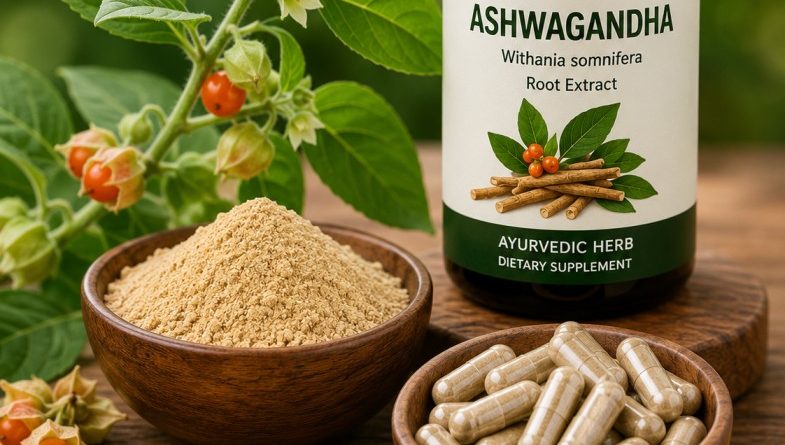
Ashwagandha (अश्वगन्धा), Withania somnifera, is among the best-known medicinal plants in Ayurveda. Traditionally classified as a Rasayana, it has long been used in contexts involving strength, nourishment, vitality and recovery.
Today, Ashwagandha supplements are promoted for almost everything from stress and sleep to testosterone, fertility, muscle building, thyroid function, diabetes and immunity.
Scientific evidence is considerably more specific.
The strongest modern evidence is currently for stress and sleep, while evidence for many other popular claims remains preliminary or insufficient.
1. What Is Ashwagandha?
Ashwagandha belongs to the Solanaceae family.
The medicinal root is widely used in Ayurveda, although different plant parts and extracts appear in commercial products.
Common names include:
- Ashwagandha
- Indian ginseng
- Winter cherry
- Withania somnifera
“Indian ginseng” is only a popular nickname.
Ashwagandha is not botanically related to true ginseng.
2. Meaning of Ashwagandha
The Sanskrit name अश्वगन्धा combines:
Ashwa (अश्व) = horse
Gandha (गन्ध) = smell/odour
The name is traditionally associated both with the characteristic smell of the root and with concepts of strength and vitality.
3. Ashwagandha in Classical Ayurveda
Ashwagandha is described in classical Ayurvedic materia medica and later Nighantus.
Traditional attributes commonly described include:
Rasa
Predominantly Madhura, Tikta and Kashaya descriptions are encountered in Ayurvedic literature.
Guna
Guru and Snigdha
Virya
Ushna
Vipaka
Madhura
Traditional descriptions can vary somewhat between texts and interpretive traditions.
4. Traditional Ayurvedic Actions
Ashwagandha is traditionally associated with concepts such as:
Rasayana
Rejuvenative/nourishing therapy.
Balya
Supporting strength.
Brimhana
Nourishing or building.
Vajikarana
Used in selected reproductive and vitality contexts.
These are Ayurvedic therapeutic categories.
They should not automatically be translated into claims such as:
“clinically proven anti-ageing drug” or “guaranteed testosterone booster.”
5. Why Is Ashwagandha So Popular Today?
Modern interest largely focuses on:
- Stress
- Anxiety
- Sleep
- Exercise performance
- Muscle strength
- Testosterone
- Male fertility
- Cognitive function
- Blood glucose
- Thyroid function
But the evidence is not equally strong for all these uses.
6. Ashwagandha and Stress
This is one of the better-studied indications.
Several randomized trials have investigated standardized Ashwagandha extracts in adults experiencing stress.
Systematic reviews suggest Ashwagandha may improve:
- Perceived stress scores
- Some anxiety measures
- Cortisol levels in some studies
However, trials differ in extract, dosage, duration and participant population.
Evidence assessment:
Promising to moderate
It is reasonable to say Ashwagandha may help reduce perceived stress in some adults.
It is not reasonable to claim it cures all stress-related illness.
7. Does Ashwagandha Lower Cortisol?
Some clinical studies report reductions in cortisol.
That does not mean:
“Cortisol is bad and Ashwagandha detoxifies it.”
Cortisol is an essential hormone involved in:
- Stress response
- Glucose regulation
- Blood pressure
- Immune function
- Circadian rhythms
The goal is normal physiological regulation—not eliminating cortisol.
8. Ashwagandha and Anxiety
Some studies show improvements in anxiety-related scores.
But there is an important distinction between:
Everyday stress/anxiety symptoms
and
Diagnosed anxiety disorders.
Evidence is not strong enough to recommend Ashwagandha as a replacement for established psychological or medical treatment of significant anxiety disorders.
9. Ashwagandha and Sleep
Sleep is another relatively promising area.
Systematic reviews of randomized trials suggest Ashwagandha may produce modest improvements in sleep quality, particularly in people experiencing insomnia or sleep difficulties.
Possible outcomes studied include:
- Sleep quality
- Sleep latency
- Total sleep time
- Sleep efficiency
Evidence assessment:
Moderate/promising
10. Ashwagandha Is Not a Sleeping Pill
The effects reported in trials are generally modest.
It should not be presented as:
“Natural sleeping tablet with no side effects.”
Persistent insomnia can be associated with:
- Sleep apnoea
- Depression
- Anxiety
- Restless legs syndrome
- Medication effects
- Alcohol
- Circadian disorders
These may require proper assessment.
11. Ashwagandha and Exercise Performance
Several small trials have examined Ashwagandha in people performing resistance training or exercise.
Some studies report improvements in:
- Strength
- Exercise performance
- VO₂ max
- Recovery
- Muscle mass
These findings are interesting but less established than basic exercise science.
Evidence assessment:
Promising but not definitive
12. Does Ashwagandha Build Muscle?
❌ MYTH
“Ashwagandha builds muscle even without training.”
✅ FACT
Resistance exercise, adequate protein, sufficient calories and recovery remain the major drivers of muscle development.
Ashwagandha may potentially provide a modest adjunctive benefit in selected settings.
It cannot replace training.
13. Ashwagandha and Testosterone
This is one of the most heavily marketed claims.
Some small studies, particularly involving men under stress, infertility or resistance training, have reported increases in testosterone.
But evidence is not strong enough to say:
“Ashwagandha boosts testosterone in every man.”
Evidence assessment:
Preliminary/promising
14. Low Testosterone Requires Diagnosis
Symptoms attributed online to “low testosterone” can have many causes:
- Sleep deprivation
- Obesity
- Depression
- Medication effects
- Thyroid disease
- Diabetes
- Sleep apnoea
- Actual hypogonadism
Diagnosis requires appropriate clinical evaluation and laboratory testing.
Do not self-diagnose testosterone deficiency from social-media symptoms.
15. Ashwagandha and Male Fertility
Some small studies have examined:
- Sperm concentration
- Sperm motility
- Semen quality
- Reproductive hormones
Results are encouraging in selected infertile male populations.
However:
Evidence remains insufficient to consider Ashwagandha a proven infertility treatment.
Male infertility has numerous possible causes and deserves appropriate evaluation.
16. Ashwagandha and Female Fertility
Claims that Ashwagandha:
- “Balances all female hormones”
- Treats PCOS
- Restores ovulation
- Cures infertility
are not supported by strong clinical evidence.
Female fertility problems require diagnosis of factors such as:
- Ovulation
- Ovarian reserve
- Tubal factors
- Endometriosis
- Thyroid disease
- Male partner factors
Evidence assessment:
Insufficient
17. Ashwagandha and Sexual Function
Small studies have investigated sexual wellbeing in both men and women.
Some improvements have been reported.
But sexual dysfunction can result from:
- Cardiovascular disease
- Diabetes
- Hormonal disorders
- Medication effects
- Psychological factors
- Relationship factors
Ashwagandha should not be promoted as a universal aphrodisiac.
18. Ashwagandha and Memory
Ashwagandha is sometimes promoted for:
- Memory
- Focus
- Cognitive performance
Small studies exist, but evidence remains preliminary.
For cognitive effects, Bacopa monnieri (Brahmi) currently has a different and somewhat more established research literature for selected memory outcomes.
Evidence assessment:
Limited/promising
19. Can Ashwagandha Prevent Alzheimer's Disease?
No convincing evidence currently demonstrates this.
Laboratory or animal findings cannot establish prevention or treatment of dementia in humans.
Claims that Ashwagandha “reverses Alzheimer's” should be avoided.
20. Ashwagandha and Diabetes
Some studies have examined effects on:
- Fasting glucose
- Insulin
- Metabolic markers
But evidence remains inadequate for Ashwagandha to replace established diabetes management.
Important:
Ashwagandha may potentially affect glucose.
People using diabetes medicines should therefore monitor carefully and seek professional advice.
21. Ashwagandha and Blood Pressure
Ashwagandha may influence blood pressure in some people.
This becomes relevant if combined with antihypertensive medication.
Possible excessive blood-pressure lowering could cause:
- Dizziness
- Weakness
- Fainting
People taking blood-pressure medicines should use medicinal doses cautiously.
22. Ashwagandha and Thyroid Function
This deserves particular attention.
Some studies and case reports suggest Ashwagandha can influence thyroid hormone levels.
Cases of thyrotoxicosis/thyroid dysfunction associated with supplementation have been reported.
Therefore, people with:
- Hyperthyroidism
- Thyroid disease
- Thyroid medication
should not casually self-prescribe Ashwagandha.
23. “Ashwagandha Naturally Cures Thyroid”
❌ MYTH
“Ashwagandha cures hypothyroidism.”
✅ FACT
Evidence is insufficient to recommend Ashwagandha as a replacement for thyroid hormone therapy.
Hypothyroidism is diagnosed through appropriate clinical assessment and tests such as:
TSH + free T4, interpreted in clinical context.
Do not stop levothyroxine because you begin Ashwagandha.
24. Ashwagandha and Immunity
Laboratory studies demonstrate various immunological effects.
However:
“Immune activity” does not equal “proven immunity booster.”
The immune system is complex.
There is insufficient evidence that taking Ashwagandha routinely prevents common infections in otherwise healthy people.
25. Autoimmune Disease
Because Ashwagandha may affect immune function, caution is warranted in people with autoimmune disorders.
This is particularly relevant for people using:
Immunosuppressive medications.
Professional review is advisable.
26. Ashwagandha and Depression
Some studies report improvements in mood-related measures, particularly when stress and anxiety are present.
However, Ashwagandha is not an established replacement for antidepressant treatment.
Depression can be serious and requires appropriate assessment.
27. Ashwagandha and Weight Loss
❌ MYTH
“Ashwagandha directly burns belly fat.”
✅ FACT
Ashwagandha is not a proven fat-burning drug.
If stress or sleep improves, this could indirectly help some people's eating and activity behaviours.
But fat loss still depends heavily on:
- Energy balance
- Diet quality
- Physical activity
- Sleep
- Metabolic factors
28. What Part of Ashwagandha Is Used?
Traditional Ayurveda commonly uses the root.
Modern supplements may contain:
- Root powder
- Root extract
- Root + leaf extract
- Different standardized extracts
These are not necessarily equivalent.
This distinction matters when interpreting research.
29. What Are Withanolides?
Ashwagandha contains steroidal lactones collectively known as withanolides.
Commercial extracts are often standardized to specified concentrations of these compounds.
But:
Higher withanolide percentage does not automatically mean a better or safer product.
Clinical outcomes depend on the entire preparation, dose and patient.
30. Powder vs Extract
Traditional powder
Often called Ashwagandha Churna.
Extract
Concentrates selected plant constituents.
A small quantity of extract may therefore not be equivalent to the same weight of raw powder.
Never compare products based only on milligrams without considering extraction and standardization.
31. What Dose Does Research Use?
There is no single scientifically established dose for every Ashwagandha preparation.
Many modern studies of standardized extracts have used doses in the range of approximately:
240–600 mg/day
depending on extract concentration and indication.
Traditional powder dosing is different and should not be equated milligram-for-milligram with concentrated extracts.
32. More Is Not Better
Increasing the dose does not guarantee:
- More testosterone
- More muscle
- Better sleep
- Faster stress reduction
Higher exposure may instead increase adverse effects.
Use the lowest appropriate evidence-informed dose when supplementation is indicated.
33. How Long Does It Take to Work?
Most clinical trials demonstrating benefit do not show an instant effect.
Studies commonly evaluate outcomes over several weeks.
Depending on the indication, research periods often range around:
6–12 weeks.
Ashwagandha should not be expected to act like an immediate sedative or stimulant.
34. Can Ashwagandha Be Taken Forever?
Long-term safety data are much more limited than short-term research.
Many trials last only weeks or a few months.
Therefore:
We cannot confidently assume that taking concentrated Ashwagandha every day for years is completely risk-free.
Periodic reassessment is sensible.
35. Common Side Effects
Ashwagandha is tolerated by many adults in short-term studies, but adverse effects can occur.
These include:
- Stomach upset
- Loose stools
- Diarrhoea
- Nausea
- Vomiting
- Drowsiness
If significant symptoms appear after starting a supplement, stop and reassess.
36. Ashwagandha and Liver Injury
This is one of the most important modern safety concerns.
Although uncommon, cases of liver injury associated with Ashwagandha supplements have been reported.
Reported presentations may include:
- Jaundice
- Itching
- Dark urine
- Nausea
- Abdominal discomfort
- Abnormal liver tests
The risk appears rare, but it should not be ignored.
37. Warning Signs Requiring Medical Attention
Stop the product and seek medical assessment if you develop:
Yellow skin or eyes
Dark urine
Persistent vomiting
Severe abdominal pain
Marked itching
Unusual severe fatigue
after beginning Ashwagandha.
38. Pregnancy
Ashwagandha is generally not recommended for routine medicinal use during pregnancy without specialist advice.
Safety has not been adequately established.
Pregnancy is not the time to assume that traditional or natural automatically means safe.
39. Breastfeeding
There is insufficient reliable safety information for medicinal Ashwagandha supplementation during breastfeeding.
Professional advice is appropriate before use.
40. Before Surgery
Ashwagandha may potentially affect:
- Sedation
- Blood pressure
- Blood glucose
Therefore, supplement use should be disclosed before surgery.
Your surgical or anaesthetic team can advise when it should be stopped.
41. Possible Drug Interactions
Particular caution is warranted with:
- Sedatives
- Sleep medicines
- Anti-anxiety medicines
- Thyroid medicines
- Diabetes medicines
- Blood-pressure medicines
- Immunosuppressants
- Anticonvulsants
Interactions are not equally well established for every medication, but caution is justified.
42. Alcohol and Ashwagandha
Combining Ashwagandha with alcohol may increase sedation in some people.
Alcohol itself can impair sleep quality despite initially making people sleepy.
Using Ashwagandha to “cancel out” alcohol-related sleep problems is not a sensible strategy.
43. Ashwagandha With Other Supplements
People often combine:
Ashwagandha + Shilajit + Ginseng + Tribulus + testosterone boosters
without knowing how the products interact.
Multiple supplements make it harder to identify the cause if:
- Liver injury
- Palpitations
- Blood-pressure changes
- Gastrointestinal symptoms
occur.
Avoid unnecessary supplement stacking.
44. Product Quality Matters
A major practical issue with herbal supplements is variability.
Look for products with:
- Clear botanical identity
- Plant part stated
- Extract information
- Batch identification
- Reliable manufacturing standards
- Contaminant testing where available
- Transparent ingredient lists
Avoid products promising:
“Guaranteed testosterone increase,”
“100% cure,” or
“Zero side effects.”
Those are warning signs, not advantages.
45. Heavy Metals and Contamination
Poor-quality herbal products may potentially contain:
- Lead
- Mercury
- Arsenic
- Pesticides
- Microbial contamination
- Undeclared pharmaceutical substances
This does not mean all Ayurvedic products are contaminated.
It means manufacturing quality matters enormously.
46. Classical Use vs Modern Supplements
Traditional Ashwagandha might be used:
- As Churna
- With appropriate Anupana
- Within compound formulations
- According to constitution and disease
- For a defined therapeutic period
Modern supplementation often becomes:
“Take two capsules every day forever.”
These are not necessarily the same therapeutic approach.
47. Ashwagandha With Milk
Classical and contemporary Ayurvedic practice sometimes uses Ashwagandha with milk or other suitable vehicles.
This may be appropriate for selected people.
But someone with:
- Milk allergy
- Lactose intolerance
- Dietary restrictions
does not need milk simply because the herb is Ayurvedic.
The Anupana should suit the individual.
48. Who Might Reasonably Consider Ashwagandha?
After appropriate assessment, an adult might consider a standardized product particularly when looking for adjunctive support with:
Stress
or
Sleep difficulties
because these currently have some of the better human evidence.
Even here, basic interventions remain important:
- Sleep schedule
- Exercise
- Stress management
- Appropriate psychological support
- Reduced excessive caffeine
- Treating underlying disease
49. Who Should Be Particularly Cautious?
Extra caution is appropriate for people who:
- Are pregnant
- Are breastfeeding
- Have thyroid disease
- Have liver disease
- Have autoimmune disease
- Are preparing for surgery
- Take sedatives
- Take diabetes medicines
- Take antihypertensive medicines
- Take immunosuppressants
- Use multiple supplements or medicines
50. Evidence Summary
| Claimed Use | Current Evidence |
|---|---|
| Stress reduction | 🟢 Moderate/promising |
| Sleep improvement | 🟢 Moderate/promising |
| Anxiety symptoms | 🟡 Promising |
| Exercise performance | 🟡 Promising |
| Muscle strength | 🟡 Promising |
| Male testosterone | 🟡 Preliminary/promising |
| Male fertility | 🟡 Preliminary |
| Memory/cognition | 🟠 Limited |
| Diabetes | 🟠 Limited |
| Thyroid treatment | 🔴 Insufficient + safety concern |
| Female infertility/PCOS | 🔴 Insufficient |
| Dementia prevention | 🔴 Insufficient |
| Weight loss/fat burning | 🔴 Insufficient |
| Universal immunity boosting | 🔴 Insufficient |
Ashwagandha: Myths vs Facts
| MYTH | FACT |
|---|---|
| Ashwagandha is completely safe because it is natural | Side effects and rare liver injury can occur |
| It boosts testosterone in every man | Evidence is limited to selected populations |
| It cures anxiety | It may help stress/anxiety symptoms but isn't a universal treatment |
| It cures thyroid disease | It may affect thyroid hormones and requires caution |
| It builds muscle without exercise | Training and nutrition remain fundamental |
| It burns belly fat | There is no convincing evidence of direct fat-burning |
| It prevents Alzheimer's disease | Human evidence is insufficient |
| Everyone should take it daily | Suitability depends on the individual |
| All Ashwagandha supplements are identical | Extracts, plant parts and concentrations vary |
| More Ashwagandha works better | Higher doses may increase adverse effects |
| It can safely be taken forever | Long-term safety data are limited |
A Sensible Evidence-Based Approach
Before using Ashwagandha:
Identify the reason for taking it
↓
Check whether evidence supports that indication
↓
Review medicines and medical conditions
↓
Choose a reputable, clearly labelled preparation
↓
Use an appropriate dose
↓
Monitor benefit and adverse effects
↓
Reassess whether continued use is necessary
Do not take a supplement indefinitely simply because it is labelled Ayurvedic.
Classical Ayurveda + Modern Science
Traditional Ayurveda gives Ashwagandha an important place within Rasayana, Balya and Brimhana therapy.
Modern clinical research suggests genuine potential, particularly for:
Stress and sleep
with emerging but less certain evidence for:
exercise performance, strength and selected reproductive outcomes.
Modern safety monitoring has also identified issues that deserve attention, particularly:
liver injury, thyroid effects and drug interactions.
This is exactly why classical knowledge and modern pharmacovigilance should complement each other.
Conclusion
Ashwagandha is neither a miracle herb nor merely hype.
It is a pharmacologically active medicinal plant with a substantial Ayurvedic history and an expanding modern evidence base.
The strongest current evidence supports possible benefits for:
Stress
Sleep
while evidence for testosterone, exercise performance, fertility and cognition remains promising but less definitive.
Claims that Ashwagandha universally treats:
diabetes, thyroid disease, PCOS, infertility, dementia, obesity or “low immunity”
go beyond the available evidence.
Most importantly:
Natural ≠ automatically safe.
Ashwagandha can cause adverse effects, interact with medicines, affect thyroid function and has been associated with rare cases of liver injury.
The best principle is therefore:
Right indication + right person + right preparation + right dose + right duration + appropriate monitoring.
That approach respects both classical Ayurveda and modern scientific evidence.
Disclaimer: This information is for general education and does not replace individualized medical advice. Do not stop prescribed medicines or use Ashwagandha to treat a diagnosed medical condition without appropriate professional guidance.
cashbackhospitalandlab.com